
Ch 39: Particles Behaving as Waves
Young & Freedman Calc - University Physics 15th Edition
Young & Freedman Calc15th EditionUniversity PhysicsISBN: 9780135159552Not the one you use?Change textbook
Chapter 38, Problem 21c

A triply ionized beryllium ion, Be3+ (a beryllium atom with three electrons removed), behaves very much like a hydrogen atom except that the nuclear charge is four times as great. For the hydrogen atom, the wavelength of the photon emitted in the n=2n = 2 to n=1n = 1 transition is 122122 nm (see Example 39.639.6). What is the wavelength of the photon emitted when a Be3+ ion undergoes this transition?

Verified step by step guidance
1
Step 1: Understand the problem. The triply ionized beryllium ion (Be3+) behaves like a hydrogen atom, but its nuclear charge (Z) is 4 instead of 1. The energy levels of such an atom are scaled by Z² compared to hydrogen. We need to calculate the wavelength of the photon emitted during the transition from n = 2 to n = 1 for Be3+.
Step 2: Recall the formula for the energy levels of a hydrogen-like atom: Eₙ = - (Z² × 13.6 eV) / n², where Z is the nuclear charge and n is the principal quantum number. For Be3+, Z = 4. Use this formula to calculate the energy difference (ΔE) between the n = 2 and n = 1 levels.
Step 3: Use the relationship between energy and wavelength for a photon: E = h × c / λ, where E is the energy of the photon, h is Planck's constant (6.626 × 10⁻³⁴ J·s), c is the speed of light (3 × 10⁸ m/s), and λ is the wavelength. Rearrange this formula to solve for λ: λ = h × c / ΔE.
Step 4: Substitute the calculated energy difference (ΔE) from Step 2 into the formula for λ. Ensure that the units are consistent (e.g., convert energy from eV to joules if necessary, using 1 eV = 1.602 × 10⁻¹⁹ J).
Step 5: Compare the result to the hydrogen atom's wavelength for the same transition (122 nm). Since the energy levels scale with Z², the wavelength for Be3+ will be shorter by a factor of Z². Use this scaling factor to verify your result.

Verified video answer for a similar problem:

This video solution was recommended by our tutors as helpful for the problem above.
Video duration:
5m
Was this helpful?

Key Concepts

Here are the essential concepts you must grasp in order to answer the question correctly.

Hydrogen-like Atoms

Hydrogen-like atoms are ions that have only one electron, similar to hydrogen, but with a different nuclear charge. The energy levels of these atoms can be calculated using the formula E_n = -Z² * 13.6 eV/n², where Z is the atomic number. For Be3+, Z = 4, which means its energy levels are influenced by a stronger nuclear charge compared to hydrogen, affecting the wavelengths of emitted photons during electronic transitions.
Recommended video:
Guided course
01:06
Charge of Atom

Energy Level Transitions

When an electron transitions between energy levels in an atom, it emits or absorbs a photon with energy equal to the difference between those levels. The energy of the emitted photon can be calculated using the formula E = hc/λ, where h is Planck's constant, c is the speed of light, and λ is the wavelength. For the Be3+ ion, the transition from n = 2 to n = 1 will release a photon with a specific wavelength that can be determined using the energy difference.
Recommended video:
Guided course
04:10
Intro to Energy & Types of Energy

Rydberg Formula

The Rydberg formula provides a way to calculate the wavelengths of spectral lines in hydrogen-like atoms. It is expressed as 1/λ = RZ²(1/n₁² - 1/n₂²), where R is the Rydberg constant, Z is the atomic number, and n₁ and n₂ are the principal quantum numbers of the initial and final states. This formula is essential for determining the wavelength of emitted photons during transitions in ions like Be3+, allowing for direct comparisons with hydrogen.
Recommended video:
Guided course
03:43
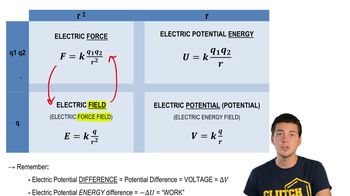
Relationships Between Force, Field, Energy, Potential
Related Practice
Textbook Question

In a set of experiments on a hypothetical one-electron atom, you measure the wavelengths of the photons emitted from transitions ending in the ground level (n=1n = 1), as shown in the energy-level diagram in Fig. E39.2739.27. You also observe that it takes 17.5017.50 eV to ionize this atom. What is the energy of the atom in each of the levels (n=1n = 1, n=2n = 2, etc.) shown in the figure?

8
views
Textbook Question

The energy-level scheme for the hypothetical one-electron element Searsium is shown in Fig. E39.25E39.25. The potential energy is taken to be zero for an electron at an infinite distance from the nucleus. An 1818-eV photon is absorbed by a Searsium atom in its ground level. As the atom returns to its ground level, what possible energies can the emitted photons have? Assume that there can be transitions between all pairs of levels.

Textbook Question

A 4.784.78-MeV alpha particle from a 226226Ra decay makes a head-on collision with a uranium nucleus. A uranium nucleus has 9292 protons.

(a) What is the distance of closest approach of the alpha particle to the center of the nucleus? Assume that the uranium nucleus remains at rest and that the distance of closest approach is much greater than the radius of the uranium nucleus.

(b) What is the force on the alpha particle at the instant when it is at the distance of closest approach?

1
views
Textbook Question

A hydrogen atom is in a state with energy 1.51-1.51 eV. In the Bohr model, what is the angular momentum of the electron in the atom, with respect to an axis at the nucleus?

Textbook Question

A triply ionized beryllium ion, Be3+ (a beryllium atom with three electrons removed), behaves very much like a hydrogen atom except that the nuclear charge is four times as great. What is the ground-level energy of Be3+? How does this compare to the ground-level energy of the hydrogen atom?

2
views
Textbook Question

Find the longest and shortest wavelengths in the Lyman and Paschen series for hydrogen. In what region of the electromagnetic spectrum does each series lie?