Ch 38: Photons: Light Waves Behaving as Particles
Young & Freedman Calc - University Physics 15th Edition
Young & Freedman Calc15th EditionUniversity PhysicsISBN: 9780135159552Not the one you use?Change textbook
Chapter 37, Problem 1

A photon of green light has a wavelength of 520520 nm. Find the photon's frequency, magnitude of momentum, and energy. Express the energy in both joules and electron volts.

Verified step by step guidance
1
To find the frequency of the photon, use the formula \( c = \lambda \nu \), where \( c \) is the speed of light (approximately \( 3 \times 10^8 \) m/s), \( \lambda \) is the wavelength (520 nm, which needs to be converted to meters), and \( \nu \) is the frequency. Rearrange the formula to solve for frequency: \( \nu = \frac{c}{\lambda} \).
Convert the wavelength from nanometers to meters by using the conversion factor \( 1 \text{ nm} = 1 \times 10^{-9} \text{ m} \). Thus, \( 520 \text{ nm} = 520 \times 10^{-9} \text{ m} \).
To find the momentum of the photon, use the formula \( p = \frac{h}{\lambda} \), where \( h \) is Planck's constant (approximately \( 6.626 \times 10^{-34} \text{ J} \cdot \text{s} \)) and \( \lambda \) is the wavelength in meters.
To find the energy of the photon in joules, use the formula \( E = h \nu \), where \( h \) is Planck's constant and \( \nu \) is the frequency you calculated earlier.
To convert the energy from joules to electron volts, use the conversion factor \( 1 \text{ eV} = 1.602 \times 10^{-19} \text{ J} \). Divide the energy in joules by this conversion factor to get the energy in electron volts.

Verified video answer for a similar problem:

This video solution was recommended by our tutors as helpful for the problem above.
Video duration:
5m
Was this helpful?

Key Concepts

Here are the essential concepts you must grasp in order to answer the question correctly.

Wave-Particle Duality

Wave-particle duality is the concept that every particle or quantum entity exhibits both wave and particle properties. For photons, this means they have a wavelength and can also be described by their momentum and energy. Understanding this duality is crucial for calculating the frequency, momentum, and energy of a photon.
Recommended video:
Guided course
07:19
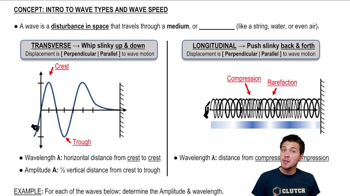
Intro to Waves and Wave Speed

Frequency-Wavelength Relationship

The frequency-wavelength relationship is described by the equation c = λν, where c is the speed of light, λ is the wavelength, and ν is the frequency. This relationship allows us to calculate the frequency of a photon when its wavelength is known, using the constant speed of light in a vacuum, approximately 3 x 10^8 m/s.
Recommended video:
Guided course
05:08
Circumference, Period, and Frequency in UCM

Photon Energy and Momentum

Photon energy is given by E = hν, where h is Planck's constant (6.626 x 10^-34 Js) and ν is the frequency. Momentum is calculated using p = E/c. Energy can be expressed in joules or electron volts (1 eV = 1.602 x 10^-19 J). These formulas are essential for determining the energy and momentum of a photon from its frequency.
Recommended video:
Guided course
09:25
Collision Problems with Motion/Energy