Textbook Question
A photon of green light has a wavelength of nm. Find the photon's frequency, magnitude of momentum, and energy. Express the energy in both joules and electron volts.
4
views

 Young & Freedman Calc 15th EditionCh 38: Photons: Light Waves Behaving as ParticlesProblem 5b
 Verified step by step guidance
 05:17
05:17
 05:08
05:08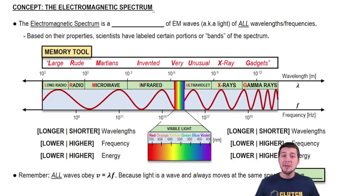 06:06
06:06A photon of green light has a wavelength of nm. Find the photon's frequency, magnitude of momentum, and energy. Express the energy in both joules and electron volts.
The photoelectric work function of potassium is eV. If light that has a wavelength of nm falls on potassium, find the stopping potential in volts.
A laser used to weld detached retinas emits light with a wavelength of nm in pulses that are ms in duration. The average power during each pulse is W. How much energy is in each pulse in joules? In electron volts?
The photoelectric work function of potassium is eV. If light that has a wavelength of nm falls on potassium, find the kinetic energy, in electron volts, of the most energetic electrons ejected.
The cathode-ray tubes that generated the picture in early color televisions were sources of x rays. If the acceleration voltage in a television tube is kV, what are the shortest-wavelength x rays produced by the television?
A photon has momentum of magnitude kg-m/s. What is the energy of this photon? Give your answer in joules and in electron volts.