

Ch 37: Special Relativity
Young & Freedman Calc - University Physics 15th Edition
Young & Freedman Calc15th EditionUniversity PhysicsISBN: 9780135159552Not the one you use?Change textbook
Chapter 36, Problem 2b

The positive muon (µ+), an unstable particle, lives on average 2.20 × 10⁻⁶ s (measured in its own frame of reference) before decaying. What average distance, measured in the laboratory, does the particle move before decaying?

Verified step by step guidance
1
Understand the problem: The muon is moving at a high velocity, and we need to calculate the average distance it travels in the laboratory frame before decaying. This involves relativistic time dilation and the relationship between velocity, time, and distance.
Step 1: Recall the time dilation formula from special relativity: t' = t / sqrt(1 - v^2/c^2), where t' is the time observed in the laboratory frame, t is the proper time (in the muon's frame), v is the velocity of the muon, and c is the speed of light.
Step 2: Calculate the dilated time t' in the laboratory frame using the given proper time t = 2.20 imes 10^{-6} \(\text{s}\) and the velocity of the muon (assumed to be close to the speed of light, v \(\text{ ≈ }\) c). Substitute these values into the time dilation formula.
Step 3: Use the relationship between distance, velocity, and time: d = v imes t', where d is the distance traveled, v is the velocity of the muon, and t' is the dilated time calculated in the previous step.
Step 4: Substitute the values of v (close to c) and t' into the distance formula to find the average distance traveled by the muon in the laboratory frame.

Verified video answer for a similar problem:

This video solution was recommended by our tutors as helpful for the problem above.
Video duration:
5m
Was this helpful?

Key Concepts

Here are the essential concepts you must grasp in order to answer the question correctly.

Time Dilation

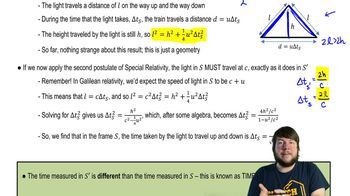
Time dilation is a phenomenon predicted by Einstein's theory of relativity, where time is observed to pass at different rates for observers in different frames of reference. For a particle moving at relativistic speeds, such as the positive muon, the time measured in the laboratory frame will differ from the time measured in the muon's rest frame. This effect must be accounted for when calculating the distance traveled before decay.
Recommended video:
Guided course
12:57
Time Dilation

Relativistic Speed

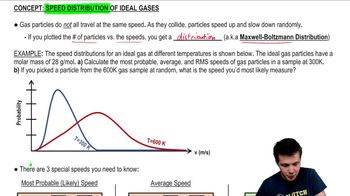
Relativistic speed refers to velocities that are a significant fraction of the speed of light (approximately 3.00 x 10^8 m/s). At these speeds, classical mechanics no longer accurately describes motion, and relativistic effects, such as increased mass and time dilation, become significant. Understanding the muon's speed is crucial for determining how far it travels in the laboratory frame before it decays.
Recommended video:
Guided course
07:59
Speed Distribution & Special Speeds of Ideal Gases

Distance Calculation

To calculate the distance traveled by the muon before it decays, one can use the formula distance = speed × time. In this case, the time must be adjusted for the laboratory frame using the time dilation formula. By knowing the muon's speed and the dilated time, one can accurately determine the average distance it travels in the laboratory before decaying.
Recommended video:
Guided course
04:15
Calculating Dot Product Using Vector Components
Related Practice
Textbook Question

As you pilot your space utility vehicle at a constant speed toward the moon, a race pilot flies past you in her spaceracer at a constant speed of 0.800c 0.800c relative to you. At the instant the spaceracer passes you, both of you start timers at zero.

(a) At the instant when you measure that the spaceracer has traveled 1.20×1081.20\(\times\)10^8 m past you, what does the race pilot read on her timer?

(b) When the race pilot reads the value calculated in part (a) on her timer, what does she measure to be your distance from her?

(c) At the instant when the race pilot reads the value calculated in part (a) on her timer, what do you read on yours?

1
views
Textbook Question

Why Are We Bombarded by Muons? Muons are unstable subatomic particles that decay to electrons with a mean lifetime of 2.2 μs. They are produced when cosmic rays bombard the upper atmosphere about 10 km above the earth's surface, and they travel very close to the speed of light. The problem we want to address is why we see any of them at the earth's surface. (a) What is the greatest distance a muon could travel during its 2.2 μs lifetime? (b) According to your answer in part (a), it would seem that muons could never make it to the ground. But the 2.2 μs lifetime is measured in the frame of the muon, and muons are moving very fast. At a speed of 0.999c, what is the mean lifetime of a muon as measured by an observer at rest on the earth? How far would the muon travel in this time? Does this result explain why we find muons in cosmic rays? (c) From the point of view of the muon, it still lives for only 2.2 μs, so how does it make it to the ground? What is the thickness of the 10 km of atmosphere through which the muon must travel, as measured by the muon? Is it now clear how the muon is able to reach the ground?

Textbook Question

Suppose the two lightning bolts shown in Fig. 37.5a are simultaneous to an observer on the train. Show that they are not simultaneous to an observer on the ground. Which lightning strike does the ground observer measure to come first?

3
views
Textbook Question

An alien spacecraft is flying overhead at a great distance as you stand in your backyard. You see its searchlight blink on for 0.1500.150 s. The first officer on the spacecraft measures that the searchlight is on for 12.012.0 ms.

(a) Which of these two measured times is the proper time?

(b) What is the speed of the spacecraft relative to the earth, expressed as a fraction of the speed of light cc?

9
views
Textbook Question

The positive muon (µ+), an unstable particle, lives on average 2.20 × 10⁻⁶ s (measured in its own frame of reference) before decaying. If such a particle is moving, with respect to the laboratory, with a speed of 0.900c, what average lifetime is measured in the laboratory?

6
views