
Ch 37: Special Relativity
Young & Freedman Calc - University Physics 15th Edition
Young & Freedman Calc15th EditionUniversity PhysicsISBN: 9780135159552Not the one you use?Change textbook
Chapter 36, Problem 2a

The positive muon (µ+), an unstable particle, lives on average 2.20 × 10⁻⁶ s (measured in its own frame of reference) before decaying. If such a particle is moving, with respect to the laboratory, with a speed of 0.900c, what average lifetime is measured in the laboratory?

Verified step by step guidance
1
Step 1: Recognize that this problem involves time dilation, a concept from Einstein's theory of special relativity. Time dilation occurs when an object moving at a significant fraction of the speed of light experiences time differently compared to an observer at rest.
Step 2: Write down the formula for time dilation: t=t0/1-v/c2, where t is the dilated time (lifetime measured in the laboratory), t0 is the proper time (lifetime measured in the muon's frame), v is the speed of the particle, and c is the speed of light.
Step 3: Substitute the given values into the formula. The proper time t0 is 2.20×10⁻⁶ seconds, the speed v is 0.900c, and c is the speed of light.
Step 4: Calculate the factor 1-v/c2. This involves squaring the ratio v/c, subtracting it from 1, and then taking the square root.
Step 5: Divide the proper time t0 by the calculated factor to find the dilated time t, which represents the average lifetime measured in the laboratory.

Verified video answer for a similar problem:

This video solution was recommended by our tutors as helpful for the problem above.
Video duration:
4m
Was this helpful?

Key Concepts

Here are the essential concepts you must grasp in order to answer the question correctly.

Time Dilation

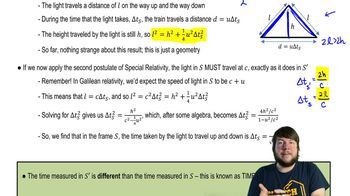
Time dilation is a phenomenon predicted by Einstein's theory of relativity, where time is measured to be moving slower for an object in motion compared to a stationary observer. This effect becomes significant at speeds approaching the speed of light (c). In the context of the muon, its lifetime as observed in the laboratory will appear longer than its proper lifetime due to its high velocity.
Recommended video:
Guided course
12:57
Time Dilation

Lorentz Factor

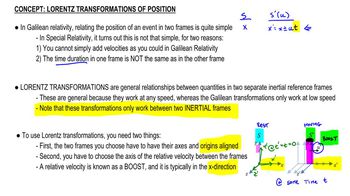
The Lorentz factor (γ) is a crucial component in the equations of special relativity, defined as γ = 1 / √(1 - v²/c²), where v is the velocity of the moving object. It quantifies the amount of time dilation and length contraction experienced by an object moving at a significant fraction of the speed of light. For the muon moving at 0.900c, the Lorentz factor will be used to calculate the dilated lifetime observed in the laboratory.
Recommended video:
Guided course
14:16
Lorentz Transformations of Position

Proper Lifetime

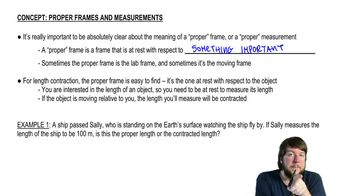
Proper lifetime refers to the lifetime of a particle as measured in its own rest frame, where it is at rest and not experiencing any relativistic effects. For the positive muon, this proper lifetime is given as 2.20 * 10^-6 seconds. When the muon is moving at relativistic speeds, its observed lifetime in another frame, such as the laboratory, will differ due to the effects of time dilation.
Recommended video:
Guided course
07:49
Proper Frames and Measurements
Related Practice
Textbook Question

As you pilot your space utility vehicle at a constant speed toward the moon, a race pilot flies past you in her spaceracer at a constant speed of 0.800c 0.800c relative to you. At the instant the spaceracer passes you, both of you start timers at zero.

(a) At the instant when you measure that the spaceracer has traveled 1.20×1081.20\(\times\)10^8 m past you, what does the race pilot read on her timer?

(b) When the race pilot reads the value calculated in part (a) on her timer, what does she measure to be your distance from her?

(c) At the instant when the race pilot reads the value calculated in part (a) on her timer, what do you read on yours?

1
views
Textbook Question

Suppose the two lightning bolts shown in Fig. 37.5a are simultaneous to an observer on the train. Show that they are not simultaneous to an observer on the ground. Which lightning strike does the ground observer measure to come first?

3
views
Textbook Question

An alien spacecraft is flying overhead at a great distance as you stand in your backyard. You see its searchlight blink on for 0.1500.150 s. The first officer on the spacecraft measures that the searchlight is on for 12.012.0 ms.

(a) Which of these two measured times is the proper time?

(b) What is the speed of the spacecraft relative to the earth, expressed as a fraction of the speed of light cc?

9
views
Textbook Question

The positive muon (µ+), an unstable particle, lives on average 2.20 × 10⁻⁶ s (measured in its own frame of reference) before decaying. What average distance, measured in the laboratory, does the particle move before decaying?

8
views