
Ch 36: Diffraction
Young & Freedman Calc - University Physics 15th Edition
Young & Freedman Calc15th EditionUniversity PhysicsISBN: 9780135159552Not the one you use?Change textbook
Chapter 35, Problem 41

The VLBA (Very Long Baseline Array) uses a number of individual radio telescopes to make one unit having an equivalent diameter of about 8000 km. When this radio telescope is focusing radio waves of wavelength 2.0 cm, what would have to be the diameter of the mirror of a visible-light telescope focusing light of wavelength 550 nm so that the visible-light telescope has the same resolution as the radio telescope?

Verified step by step guidance
1
The resolution of a telescope is determined by the formula for angular resolution: θ = 1.22 * (λ / D), where θ is the angular resolution, λ is the wavelength of the light or radio waves, and D is the diameter of the telescope's aperture.
To ensure the visible-light telescope has the same resolution as the radio telescope, the angular resolution θ must be the same for both. Therefore, we can set up the equation: 1.22 * (λ_radio / D_radio) = 1.22 * (λ_visible / D_visible).
Simplify the equation by canceling out the common factor 1.22: (λ_radio / D_radio) = (λ_visible / D_visible).
Rearrange the equation to solve for D_visible: D_visible = (λ_visible * D_radio) / λ_radio.
Substitute the given values into the equation: λ_radio = 2.0 cm = 0.02 m, D_radio = 8000 km = 8,000,000 m, and λ_visible = 550 nm = 550 * 10^(-9) m. Perform the substitution and simplify to find the required diameter of the visible-light telescope's mirror.

Verified video answer for a similar problem:

This video solution was recommended by our tutors as helpful for the problem above.
Video duration:
4m
Was this helpful?

Key Concepts

Here are the essential concepts you must grasp in order to answer the question correctly.

Resolution in Telescopes

Resolution refers to the ability of a telescope to distinguish between two closely spaced objects. It is determined by the diameter of the telescope's aperture and the wavelength of light being observed. A larger aperture allows for better resolution, enabling the telescope to resolve finer details in the observed objects.
Recommended video:

Diffraction Limit

The diffraction limit is a fundamental limit to the resolution of optical systems, including telescopes, caused by the wave nature of light. It can be quantified using the formula θ = 1.22(λ/D), where θ is the angular resolution in radians, λ is the wavelength of light, and D is the diameter of the aperture. This principle explains why longer wavelengths result in poorer resolution.
Recommended video:

Wavelength Comparison

Wavelength is a key factor in determining the resolution of telescopes. In this context, the VLBA operates at a wavelength of 2.0 cm (20,000 nm), while the visible-light telescope operates at 550 nm. To achieve the same resolution, the diameter of the visible-light telescope must be calculated based on the ratio of these wavelengths, highlighting the relationship between wavelength and aperture size.
Recommended video:
Guided course
05:42
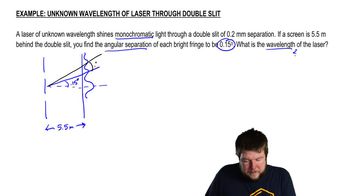
Unknown Wavelength of Laser through Double Slit
Related Practice
Textbook Question

If the planes of a crystal are 3.50 Å (1 Å = 10-10 m = 1 Ångstrom unit) apart, what wavelength of electromagnetic waves is needed so that the first strong interference maximum in the Bragg reflection occurs when the waves strike the planes at an angle of 22.0°, and in what part of the electromagnetic spectrum do these waves lie?

2
views
Textbook Question

The Hubble Space Telescope has an aperture of 2.4 m and focuses visible light (380 - 750 nm). The Arecibo radio telescope in Puerto Rico is 305 m (1000 ft) in diameter (it is built in a mountain valley) and focuses radio waves of wavelength 75 cm. Under optimal viewing conditions, what is the smallest crater that each of these telescopes could resolve on our moon?

1
views
Textbook Question

Two satellites at an altitude of 1200 km are separated by 28 km. If they broadcast 3.6 cm microwaves, what minimum receiving-dish diameter is needed to resolve (by Rayleigh’s criterion) the two transmissions?

1
views
Textbook Question

A wildlife photographer uses a moderate telephoto lens of focal length 135 mm and maximum aperture f/4.00 to photograph a bear that is 11.5 m away. Assume the wavelength is 550 nm. (a) What is the width of the smallest feature on the bear that this lens can resolve if it is opened to its maximum aperture? (b) If, to gain depth of field, the photographer stops the lens down to f/22.0, what would be the width of the smallest resolvable feature on the bear?

1
views
Textbook Question

If you can read the bottom row of your doctor’s eye chart, your eye has a resolving power of 1 arcminute, equal to 1/60 degree. If this resolving power is diffraction-limited, to what effective diameter of your eye’s optical system does this correspond? Use Rayleigh’s criterion and assume λ = 550 nm.

1
views