
Ch 36: Diffraction
Young & Freedman Calc - University Physics 15th Edition
Young & Freedman Calc15th EditionUniversity PhysicsISBN: 9780135159552Not the one you use?Change textbook
Chapter 35, Problem 43a

The Hubble Space Telescope has an aperture of 2.4 m and focuses visible light (380 - 750 nm). The Arecibo radio telescope in Puerto Rico is 305 m (1000 ft) in diameter (it is built in a mountain valley) and focuses radio waves of wavelength 75 cm. Under optimal viewing conditions, what is the smallest crater that each of these telescopes could resolve on our moon?

Verified step by step guidance
1
Determine the formula for the angular resolution of a telescope, which is given by the Rayleigh criterion: θ = 1.22 * (λ / D), where θ is the angular resolution in radians, λ is the wavelength of light or radio waves, and D is the diameter (aperture) of the telescope.
Calculate the angular resolution for the Hubble Space Telescope. Use the shortest wavelength of visible light (λ = 380 nm = 380 × 10⁻⁹ m) and the aperture of the Hubble Space Telescope (D = 2.4 m). Substitute these values into the formula: θ_Hubble = 1.22 * (λ / D).
Calculate the angular resolution for the Arecibo radio telescope. Use the wavelength of the radio waves (λ = 75 cm = 0.75 m) and the diameter of the Arecibo telescope (D = 305 m). Substitute these values into the formula: θ_Arecibo = 1.22 * (λ / D).
Relate the angular resolution to the smallest resolvable feature on the moon. The smallest resolvable feature (s) can be calculated using the formula: s = θ * d, where d is the distance to the moon (approximately 384,400 km = 3.844 × 10⁸ m). Use the angular resolutions calculated in the previous steps to find s_Hubble and s_Arecibo.
Compare the results for the Hubble Space Telescope and the Arecibo radio telescope to determine the smallest crater each can resolve on the moon. Note that the smaller the value of s, the better the resolution of the telescope.

Verified video answer for a similar problem:

This video solution was recommended by our tutors as helpful for the problem above.
Video duration:
9m
Was this helpful?

Key Concepts

Here are the essential concepts you must grasp in order to answer the question correctly.

Resolution

Resolution refers to the ability of a telescope to distinguish between two closely spaced objects. It is determined by the aperture size and the wavelength of light being observed. The smaller the resolution limit, the finer the detail that can be seen. For optical telescopes, resolution is often expressed in arcseconds, while for radio telescopes, it can be related to the physical size of the telescope and the wavelength of the radio waves.

Diffraction Limit

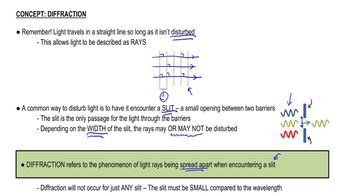
The diffraction limit is the fundamental limit to the resolution of a telescope due to the wave nature of light. It can be calculated using the formula θ = 1.22(λ/D), where θ is the angular resolution in radians, λ is the wavelength of light, and D is the diameter of the telescope's aperture. This concept is crucial for understanding how the size of the telescope and the wavelength of the observed light affect the smallest detail that can be resolved.
Recommended video:

Wavelength and Aperture Size

The wavelength of light or radio waves plays a significant role in determining the resolving power of a telescope. Shorter wavelengths (like visible light) allow for finer details to be resolved compared to longer wavelengths (like radio waves). Additionally, a larger aperture size increases the amount of light collected and improves resolution, enabling the telescope to resolve smaller features on distant objects, such as craters on the moon.
Recommended video:
Guided course
05:42
Unknown Wavelength of Laser through Double Slit