

Ch 36: Diffraction
Young & Freedman Calc - University Physics 15th Edition
Young & Freedman Calc15th EditionUniversity PhysicsISBN: 9780135159552Not the one you use?Change textbook
Chapter 35, Problem 18

Parallel rays of monochromatic light with wavelength 568 nm illuminate two identical slits and produce an interference pattern on a screen that is 75.0 cm from the slits. The centers of the slits are 0.640 mm apart and the width of each slit is 0.434 mm. If the intensity at the center of the central maximum is 5.00 x 10⁻⁴ W/m2, what is the intensity at a point on the screen that is 0.900 mm from the center of the central maximum?

Verified step by step guidance
1
Step 1: Understand the problem. This is a double-slit interference problem where we need to calculate the intensity at a point on the screen that is 0.900 mm from the center of the central maximum. The given parameters include the wavelength of light (λ = 568 nm), the distance between the slits (d = 0.640 mm), the slit width (a = 0.434 mm), the distance to the screen (L = 75.0 cm), and the intensity at the central maximum (I₀ = 5.00×10⁻⁴ W/m²).
Step 2: Calculate the path difference. The path difference between the light from the two slits at a point on the screen is given by Δx = (d * y) / L, where y is the distance from the central maximum on the screen. Substitute the values: d = 0.640 mm, y = 0.900 mm, and L = 75.0 cm. Ensure all units are consistent (convert mm to meters where necessary).
Step 3: Determine the phase difference. The phase difference (Δϕ) is related to the path difference by the formula Δϕ = (2π / λ) * Δx, where λ is the wavelength of the light. Use the calculated path difference from Step 2 and λ = 568 nm (convert to meters) to find Δϕ.
Step 4: Use the intensity formula for interference. The intensity at a point on the screen is given by I = I₀ * cos²(Δϕ / 2), where I₀ is the intensity at the central maximum and Δϕ is the phase difference. Substitute the values of I₀ and Δϕ to find the intensity at the given point.
Step 5: Account for the single-slit diffraction envelope. The double-slit interference pattern is modulated by the single-slit diffraction envelope. The single-slit diffraction factor is given by sinc²(β), where β = (π * a * y) / (λ * L). Calculate β using the given slit width (a = 0.434 mm), y = 0.900 mm, λ = 568 nm, and L = 75.0 cm. Multiply the interference intensity by sinc²(β) to get the final intensity at the point.

Verified video answer for a similar problem:

This video solution was recommended by our tutors as helpful for the problem above.
Video duration:
10m
Was this helpful?

Key Concepts

Here are the essential concepts you must grasp in order to answer the question correctly.

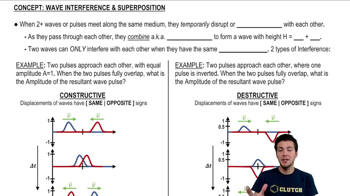
Interference of Light

Interference occurs when two or more coherent light waves overlap, resulting in a new wave pattern. In the context of the double-slit experiment, constructive interference leads to bright fringes, while destructive interference results in dark fringes. The positions of these fringes depend on the wavelength of the light and the geometry of the slits.
Recommended video:
Guided course
03:47
Wave Interference & Superposition

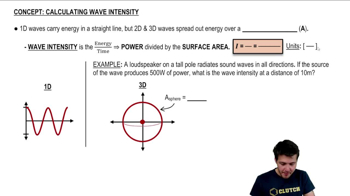
Intensity of Light

The intensity of light is defined as the power per unit area, typically measured in watts per square meter (W/m²). In interference patterns, the intensity varies depending on the position relative to the central maximum, influenced by the phase difference between the light waves from the slits. The intensity at any point can be calculated using the formula that incorporates the amplitude of the waves and their interference.
Recommended video:
Guided course
02:32
Wave Intensity

Young's Double-Slit Experiment

Young's double-slit experiment demonstrates the wave nature of light through the creation of an interference pattern. The distance between the slits, the wavelength of the light, and the distance to the screen are critical parameters that determine the spacing and intensity of the interference fringes. This experiment is foundational in understanding wave optics and the behavior of light.
Recommended video:
Guided course
12:00
Young's Double Slit Experiment
Related Practice
Textbook Question

Laser light of wavelength 500.0 nm illuminates two identical slits, producing an interference pattern on a screen 90.0 cm from the slits. The bright bands are 1.00 cm apart, and the third bright bands on either side of the central maximum are missing in the pattern. Find the width and the separation of the two slits.

1
views
Textbook Question

When laser light of wavelength 632.8 nm passes through a diffraction grating, the first bright spots occur at ±17.8° from the central maximum. (a) What is the line density (in lines/cm) of this grating? (b) How many additional bright spots are there beyond the first bright spots, and at what angles do they occur?

1
views
Textbook Question

A series of parallel linear water wave fronts are traveling directly toward the shore at 15.0 cm/s on an otherwise placid lake. A long concrete barrier that runs parallel to the shore at a distance of 3.20 m away has a hole in it. You count the wave crests and observe that 75.0 of them pass by each minute, and you also observe that no waves reach the shore at ±61.3 cm from the point directly opposite the hole, but waves do reach the shore everywhere within this distance. At what other angles do you find no waves hitting the shore?

2
views
Textbook Question

If a diffraction grating produces a third-order bright spot for red light (of wavelength 700 nm) at 65.0° from the central maximum, at what angle will the second-order bright spot be for violet light (of wavelength 400 nm)?

1
views
Textbook Question

Monochromatic light of wavelength 592 nm from a distant source passes through a slit that is 0.0290 mm wide. In the resulting diffraction pattern, the intensity at the center of the central maximum (θ = 0°) is 4.00x10⁻⁵ W/m2. What is the intensity at a point on the screen that corresponds to θ = 1.20°?

Textbook Question

Monochromatic light of wavelength 580 nm passes through a single slit and the diffraction pattern is observed on a screen. Both the source and screen are far enough from the slit for Fraunhofer diffraction to apply. (a) If the first diffraction minima are at ±90.0°, so the central maximum completely fills the screen, what is the width of the slit? (b) For the width of the slit as calculated in part (a), what is the ratio of the intensity at θ = 45.0° to the intensity at θ = 0?

2
views