
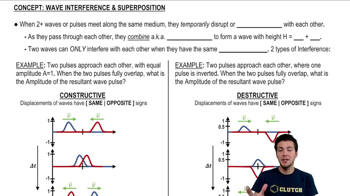
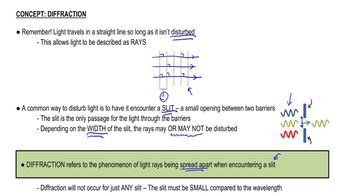
Diffraction occurs for all types of waves, including sound waves. High-frequency sound from a distant source with wavelength 9.00 cm passes through a slit 12.0 cm wide. A microphone is placed 8.00 m directly in front of the center of the slit, corresponding to point O in Fig. 36.5a . The microphone is then moved in a direction perpendicular to the line from the center of the slit to point O. At what distances from O will the intensity detected by the microphone be zero?
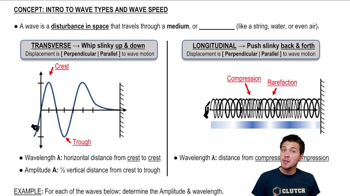
A series of parallel linear water wave fronts are traveling directly toward the shore at 15.0 cm/s on an otherwise placid lake. A long concrete barrier that runs parallel to the shore at a distance of 3.20 m away has a hole in it. You count the wave crests and observe that 75.0 of them pass by each minute, and you also observe that no waves reach the shore at ±61.3 cm from the point directly opposite the hole, but waves do reach the shore everywhere within this distance. At what other angles do you find no waves hitting the shore?
Verified step by step guidance
Verified video answer for a similar problem:
Key Concepts
Wave Interference
Diffraction
Wave Speed and Frequency
Parallel rays of monochromatic light with wavelength 568 nm illuminate two identical slits and produce an interference pattern on a screen that is 75.0 cm from the slits. The centers of the slits are 0.640 mm apart and the width of each slit is 0.434 mm. If the intensity at the center of the central maximum is 5.00 x 10⁻⁴ W/m2, what is the intensity at a point on the screen that is 0.900 mm from the center of the central maximum?
A series of parallel linear water wave fronts are traveling directly toward the shore at 15.0 cm/s on an otherwise placid lake. A long concrete barrier that runs parallel to the shore at a distance of 3.20 m away has a hole in it. You count the wave crests and observe that 75.0 of them pass by each minute, and you also observe that no waves reach the shore at ±61.3 cm from the point directly opposite the hole, but waves do reach the shore everywhere within this distance. How wide is the hole in the barrier?
Light of wavelength 585 nm falls on a slit 0.0666 mm wide. (a) On a very large and distant screen, how many totally dark fringes (indicating complete cancellation) will there be, including both sides of the central bright spot? Solve this problem without calculating all the angles! (Hint: What is the largest that sin u can be? What does this tell you is the largest that m can be?) (b) At what angle will the dark fringe that is most distant from the central bright fringe occur?
Monochromatic light of wavelength 592 nm from a distant source passes through a slit that is 0.0290 mm wide. In the resulting diffraction pattern, the intensity at the center of the central maximum (θ = 0°) is 4.00x10⁻⁵ W/m2. What is the intensity at a point on the screen that corresponds to θ = 1.20°?
Monochromatic light of wavelength 580 nm passes through a single slit and the diffraction pattern is observed on a screen. Both the source and screen are far enough from the slit for Fraunhofer diffraction to apply. (a) If the first diffraction minima are at ±90.0°, so the central maximum completely fills the screen, what is the width of the slit? (b) For the width of the slit as calculated in part (a), what is the ratio of the intensity at θ = 45.0° to the intensity at θ = 0?
