Ch 35: Interference
Young & Freedman Calc - University Physics 15th Edition
Young & Freedman Calc15th EditionUniversity PhysicsISBN: 9780135159552Not the one you use?Change textbook
Chapter 34, Problem 23

What is the thinnest film of a coating with n = 1.42 on glass (n = 1.52) for which destructive interference of the red component (650 nm) of an incident white light beam in air can take place by reflection?

Verified step by step guidance
1
Determine the condition for destructive interference. For thin films, destructive interference occurs when the optical path difference between the reflected waves is equal to an odd multiple of half the wavelength in the film. This can be expressed as: \( 2n t = (m + \frac{1}{2}) \lambda_{film} \), where \( n \) is the refractive index of the film, \( t \) is the thickness of the film, \( m \) is an integer (0, 1, 2,...), and \( \lambda_{film} \) is the wavelength of light in the film.
Calculate the wavelength of light in the film. The wavelength in the film is related to the wavelength in air by \( \lambda_{film} = \frac{\lambda_{air}}{n} \), where \( \lambda_{air} \) is the wavelength of light in air (650 nm in this case) and \( n \) is the refractive index of the film (1.42).
Substitute \( \lambda_{film} \) into the interference condition. Replace \( \lambda_{film} \) in the equation \( 2n t = (m + \frac{1}{2}) \lambda_{film} \) with \( \frac{\lambda_{air}}{n} \). This gives \( 2n t = (m + \frac{1}{2}) \frac{\lambda_{air}}{n} \).
Solve for the thickness \( t \). Rearrange the equation to isolate \( t \): \( t = \frac{(m + \frac{1}{2}) \lambda_{air}}{2n^2} \).
Find the thinnest film by using the smallest value of \( m \), which is \( m = 0 \). Substitute \( m = 0 \), \( \lambda_{air} = 650 \text{ nm} \), and \( n = 1.42 \) into the equation for \( t \) to calculate the minimum thickness of the film.

Verified video answer for a similar problem:

This video solution was recommended by our tutors as helpful for the problem above.
Video duration:
2m
Was this helpful?

Key Concepts

Here are the essential concepts you must grasp in order to answer the question correctly.

Thin Film Interference

Thin film interference occurs when light waves reflect off the boundaries of a thin layer, such as a coating on glass. The reflected waves can interfere constructively or destructively depending on their phase difference, which is influenced by the film's thickness and the refractive indices of the materials involved.
Recommended video:
Guided course
03:47
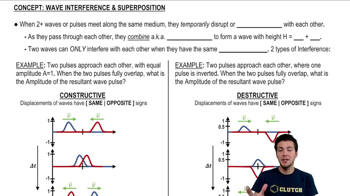
Wave Interference & Superposition

Refractive Index

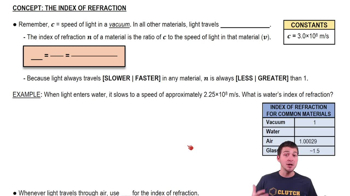
The refractive index (n) is a dimensionless number that describes how light propagates through a medium. It is defined as the ratio of the speed of light in a vacuum to the speed of light in the medium. In this context, the refractive indices of the coating and glass determine how light behaves at their interfaces, affecting interference patterns.
Recommended video:
Guided course
03:46
Index of Refraction

Destructive Interference

Destructive interference occurs when two light waves combine in such a way that their amplitudes cancel each other out, resulting in reduced or no intensity. For thin films, this typically happens when the path difference between reflected waves is equal to an odd multiple of half the wavelength, leading to specific conditions for thickness to achieve this effect.
Recommended video:
Guided course
03:47
Wave Interference & Superposition
Related Practice
Textbook Question

In a two-slit interference pattern, the intensity at the peak of the central maximum is I0. At a point in the pattern where the phase difference between the waves from the two slits is 60.0°, what is the intensity?

1
views
Textbook Question

Two slits spaced 0.260 mm apart are 0.900 m from a screen and illuminated by coherent light of wavelength 660 nm. The intensity at the center of the central maximum (u = 0°) is I0. What is the distance on the screen from the center of the central maximum to the point where the intensity has fallen to I0/2?

1
views
Textbook Question

Two slits spaced 0.260 mm apart are 0.900 m from a screen and illuminated by coherent light of wavelength 660 nm. The intensity at the center of the central maximum (u = 0°) is I0. What is the distance on the screen from the center of the central maximum to the first minimum

3
views
Textbook Question

A uniform film of TiO2, 1036 nm thick and having index of refraction 2.62, is spread uniformly over the surface of crown glass of refractive index 1.52. Light of wavelength 520.0 nm falls at normal incidence onto the film from air. You want to increase the thickness of this film so that the reflected light cancels. What is the minimum thickness of TiO2 that you must add so the reflected light cancels as desired?

1
views
Textbook Question

How far must the mirror M2 (see Fig. 35.19) of the Michelson interferometer be moved so that 1800 fringes of He-Ne laser light (λ = 633 nm) move across a line in the field of view?

<Image>

1
views
Textbook Question

When viewing a piece of art that is behind glass, one often is affected by the light that is reflected off the front of the glass (called glare), which can make it difficult to see the art clearly. One solution is to coat the outer surface of the glass with a film to cancel part of the glare. If the glass has a refractive index of 1.62 and you use TiO2, which has an index of refraction of 2.62, as the coating, what is the minimum film thickness that will cancel light of wavelength 505 nm?

2
views