
Ch 35: Interference
Young & Freedman Calc - University Physics 15th Edition
Young & Freedman Calc15th EditionUniversity PhysicsISBN: 9780135159552Not the one you use?Change textbook
Chapter 34, Problem 31

How far must the mirror M2 (see Fig. 35.19) of the Michelson interferometer be moved so that 1800 fringes of He-Ne laser light (λ = 633 nm) move across a line in the field of view?
<Image>

Verified step by step guidance
1
Understand the problem: The Michelson interferometer produces interference fringes when the path length difference between the two arms changes. The number of fringes observed corresponds to the number of wavelengths of light that fit into the change in path length. Here, we are tasked with finding the distance the mirror M2 must be moved to produce 1800 fringes for He-Ne laser light with a wavelength of 633 nm.
Recall the relationship between the number of fringes (N), the wavelength of light (λ), and the change in path length (ΔL). The formula is: ΔL = N × λ. However, in a Michelson interferometer, moving one mirror by a distance d changes the path length by 2d because the light travels to the mirror and back. Thus, the formula becomes: 2d = N × λ.
Rearrange the formula to solve for the distance the mirror must be moved (d): d = (N × λ) / 2.
Substitute the given values into the formula: N = 1800 fringes and λ = 633 nm (convert this to meters: 633 nm = 633 × 10⁻⁹ m). The formula becomes: d = (1800 × 633 × 10⁻⁹) / 2.
Perform the calculation to find the value of d. Ensure the units are consistent and the result is expressed in meters. This will give the distance the mirror M2 must be moved to produce 1800 fringes.

Verified video answer for a similar problem:

This video solution was recommended by our tutors as helpful for the problem above.
Was this helpful?

Key Concepts

Here are the essential concepts you must grasp in order to answer the question correctly.

Interference

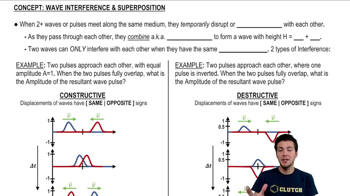
Interference is a phenomenon that occurs when two or more waves overlap, resulting in a new wave pattern. In the context of the Michelson interferometer, light waves from a coherent source, like a He-Ne laser, combine to produce bright and dark fringes due to constructive and destructive interference. The position and number of these fringes are crucial for measuring changes in optical path length.
Recommended video:
Guided course
03:47
Wave Interference & Superposition

Fringe Count

Fringe count refers to the number of bright or dark bands observed in an interference pattern. In the Michelson interferometer, moving one of the mirrors changes the optical path length, causing the fringes to shift. The total number of fringes that move across a line in the field of view is directly related to the distance the mirror is moved and the wavelength of the light used.
Recommended video:
Guided course
04:44
Counting Significant Figures

Wavelength

Wavelength is the distance between successive peaks of a wave, typically measured in nanometers for light. In this problem, the wavelength of the He-Ne laser light is given as 633 nm. The relationship between the movement of the mirror and the number of fringes observed is determined by the wavelength, as each complete cycle of fringe movement corresponds to a change in optical path length equal to one wavelength.
Recommended video:
Guided course
05:42
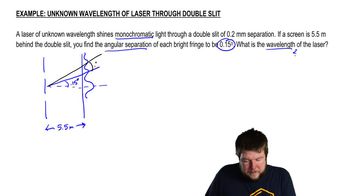
Unknown Wavelength of Laser through Double Slit