


Ch 34: Geometric Optics
Young & Freedman Calc - University Physics 15th Edition
Young & Freedman Calc15th EditionUniversity PhysicsISBN: 9780135159552Not the one you use?Change textbook
Chapter 33, Problem 26

The left end of a long glass rod 8.00 cm in diameter, with an index of refraction of 1.60, is ground and polished to a convex hemispherical surface with a radius of 4.00 cm. An object in the form of an arrow 1.50 mm tall, at right angles to the axis of the rod, is located on the axis 24.0 cm to the left of the vertex of the convex surface. Find the position and height of the of the arrow formed by paraxial rays incident on the convex surface. Is the erect or inverted?

Verified step by step guidance
1
Step 1: Identify the problem as one involving refraction at a spherical surface. Use the formula for refraction at a spherical surface: n2s2n1s1 = n2n1R, where n1 and n2 are the indices of refraction of the initial and final media, s1 and s2 are the object and image distances, and R is the radius of curvature of the surface.
Step 2: Assign the given values: n1 = 1.00 (air), n2 = 1.60 (glass), s1 = −24.0 cm (negative because the object is on the same side as the incoming light), and R = 4.00 cm (positive because the center of curvature is on the same side as the outgoing light). Substitute these values into the formula.
Step 3: Solve for s2, the image distance. Rearrange the formula to isolate s2: s2 = n2s1Rn1R + (n2n1)s1. Substitute the known values into this equation.
Step 4: Determine the magnification of the image using the magnification formula: m = −s2s1. Use the value of s2 obtained in the previous step and the given s1 to calculate the magnification.
Step 5: Calculate the height of the image using the magnification: himage = mhobject. Substitute the given object height (hobject = 1.50 mm) and the magnification obtained in the previous step. Finally, determine whether the image is erect or inverted based on the sign of the magnification (positive for erect, negative for inverted).

Verified video answer for a similar problem:

This video solution was recommended by our tutors as helpful for the problem above.
Video duration:
4m
Was this helpful?

Key Concepts

Here are the essential concepts you must grasp in order to answer the question correctly.

Refraction and the Index of Refraction

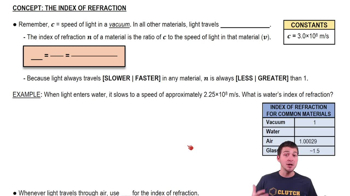
Refraction is the bending of light as it passes from one medium to another, which occurs due to a change in its speed. The index of refraction (n) quantifies this effect, defined as the ratio of the speed of light in a vacuum to its speed in the medium. For example, an index of refraction of 1.60 indicates that light travels 1.60 times slower in glass than in a vacuum, affecting how light rays converge or diverge when they hit a surface.
Recommended video:
Guided course
03:46
Index of Refraction

Convex Lens and Image Formation

A convex lens is thicker at the center than at the edges and converges incoming parallel light rays to a focal point. The position and characteristics of the image formed by a convex lens can be determined using the lens formula (1/f = 1/do + 1/di) and magnification equations. The nature of the image (real or virtual, erect or inverted) depends on the object's position relative to the focal length.
Recommended video:
07:58
Thin Lens Equation

Paraxial Rays and Ray Diagrams

Paraxial rays are light rays that make small angles with the optical axis of a lens or mirror, allowing for simplified calculations in optics. Ray diagrams utilize these rays to trace the path of light through optical systems, helping to determine the position and size of images. In this context, analyzing paraxial rays is essential for predicting how the arrow's image will be formed by the convex surface of the rod.
Recommended video:
06:37
Ray Diagrams for Converging Lenses
Related Practice
Textbook Question

A person is lying on a diving board 3.00 m above the surface of the water in a swimming pool. She looks at a penny that is on the bottom of the pool directly below her. To her, the penny appears to be a distance of 7.00 m from her. What is the depth of the water at this point?

3
views
Textbook Question

The glass rod of Exercise 34.22 is immersed in oil (n = 1.45). An object placed to the left of the rod on the rod's axis is to be d 1.20 m inside the rod. How far from the left end of the rod must the object be located to form the image?

5
views
Textbook Question

A converging lens with a focal length of 70.0 cm forms an image of a 3.20 cm tall real object that is to the left of the lens. The image is 4.50 cm tall and inverted. Where are the object and image located in relation to the lens? Is the image real or virtual?

1
views
Textbook Question

A lens forms an of an object. The object is 16.0 cm from the lens. The is 12.0 cm from the lens on the same side as the object. What is the focal length of the lens? Is the lens converging or diverging?

2
views
Textbook Question

A converging lens with a focal length of 9.00 cm forms an image of a 4.00 mm tall real object that is to the left of the lens. The image is 1.30 cm tall and erect. Where are the object and image located? Is the image real or virtual?

1
views
Textbook Question

A Spherical Fish Bowl. A small tropical fish is at the center of a water-filled, spherical fish bowl 28.0 cm in diameter. Find the apparent position and magnification of the fish to an observer outside the bowl. The effect of the thin walls of the bowl may be ignored.

3
views