Ch 34: Geometric Optics
Young & Freedman Calc - University Physics 15th Edition
Young & Freedman Calc15th EditionUniversity PhysicsISBN: 9780135159552Not the one you use?Change textbook
Chapter 33, Problem 36

A converging lens with a focal length of 9.00 cm forms an image of a 4.00 mm tall real object that is to the left of the lens. The image is 1.30 cm tall and erect. Where are the object and image located? Is the image real or virtual?

Verified step by step guidance
1
Identify the given values: The focal length of the lens \( f = 9.00 \, \text{cm} \), the height of the object \( h_o = 4.00 \, \text{mm} \), the height of the image \( h_i = 1.30 \text{ cm} \), and the image is erect. Note that the height of the image being erect indicates that the image is virtual.
Use the magnification formula \( M = \frac{h_i}{h_o} \) to calculate the magnification. Convert the object height to centimeters for consistency: \( h_o = 0.400 \, \text{cm} \). Substitute the values into the formula: \( M = \frac{1.30}{0.400} \).
Relate the magnification to the object and image distances using the formula \( M = -\frac{d_i}{d_o} \). Since the image is erect, the magnification \( M \) is positive. Rearrange the formula to express \( d_i \) in terms of \( d_o \): \( d_i = M \cdot d_o \).
Apply the lens equation \( \frac{1}{f} = \frac{1}{d_o} + \frac{1}{d_i} \). Substitute \( d_i = M \cdot d_o \) into the lens equation: \( \frac{1}{f} = \frac{1}{d_o} + \frac{1}{M \cdot d_o} \). Combine the terms on the right-hand side: \( \frac{1}{f} = \frac{1 + M}{d_o} \). Rearrange to solve for \( d_o \): \( d_o = \frac{1 + M}{f} \).
Once \( d_o \) (the object distance) is found, substitute it back into \( d_i = M \cdot d_o \) to find the image distance \( d_i \). Finally, confirm that the image is virtual because \( d_i \) will be negative, indicating that the image is on the same side of the lens as the object.

Verified video answer for a similar problem:

This video solution was recommended by our tutors as helpful for the problem above.
Video duration:
5m
Was this helpful?

Key Concepts

Here are the essential concepts you must grasp in order to answer the question correctly.

Converging Lens

A converging lens, or convex lens, is a transparent optical device that bends light rays inward to a focal point. It has a positive focal length, meaning it can form real images when the object is placed outside its focal length. The behavior of light through a converging lens is governed by the lens formula, which relates the object distance, image distance, and focal length.
Recommended video:
07:58
Thin Lens Equation

Magnification

Magnification is the ratio of the height of the image to the height of the object, and it also relates to the distances of the object and image from the lens. It can be calculated using the formula: magnification (m) = height of image (h') / height of object (h) = - (image distance (v) / object distance (u)). A positive magnification indicates an erect image, while a negative value indicates an inverted image.
Recommended video:
09:03
Mirror Equation

Real vs. Virtual Images

Real images are formed when light rays converge and can be projected onto a screen, while virtual images occur when light rays appear to diverge from a point behind the lens and cannot be projected. In the case of a converging lens, a real image is formed when the object is placed outside the focal length, whereas a virtual image is formed when the object is within the focal length. Understanding this distinction is crucial for analyzing lens behavior.
Recommended video:
Guided course
03:41
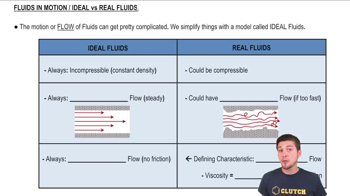
Ideal vs Real Fluids
Related Practice
Textbook Question

A lensmaker wants to make a magnifying glass from glass that has an index of refraction n = 1.55 and a focal length of 20.0 cm. If the two surfaces of the lens are to have equal radii, what should that radius be?

1
views
Textbook Question

The left end of a long glass rod 8.00 cm in diameter, with an index of refraction of 1.60, is ground and polished to a convex hemispherical surface with a radius of 4.00 cm. An object in the form of an arrow 1.50 mm tall, at right angles to the axis of the rod, is located on the axis 24.0 cm to the left of the vertex of the convex surface. Find the position and height of the of the arrow formed by paraxial rays incident on the convex surface. Is the erect or inverted?

2
views
Textbook Question

An object is 16.0 cm to the left of a lens. The lens forms an image 36.0 cm to the right of the lens. Draw a principal-ray diagram.

2
views
Textbook Question

A converging lens with a focal length of 70.0 cm forms an image of a 3.20 cm tall real object that is to the left of the lens. The image is 4.50 cm tall and inverted. Where are the object and image located in relation to the lens? Is the image real or virtual?

1
views
Textbook Question

An object is 16.0 cm to the left of a lens. The lens forms an image 36.0 cm to the right of the lens. If the object is 8.00 mm tall, how tall is the image? Is it erect or inverted?

1
views
Textbook Question

A lens forms an of an object. The object is 16.0 cm from the lens. The is 12.0 cm from the lens on the same side as the object. What is the focal length of the lens? Is the lens converging or diverging?

2
views