
Textbook Question
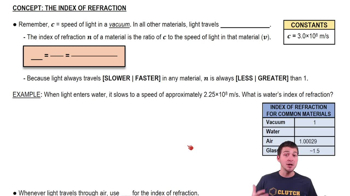
A beam of light has a wavelength of 650 nm in vacuum. What is the wavelength of these waves in the liquid?
2
views
 Verified step by step guidance
 03:46
03:46
 05:08
05:08 03:41
03:41A beam of light has a wavelength of 650 nm in vacuum. What is the wavelength of these waves in the liquid?
As shown in Fig. E33.11, a layer of water covers a slab of material X in a beaker. A ray of light traveling upward follows the path indicated. Using the information on the figure, find the angle the light makes with the normal in the air.
Two plane mirrors intersect at right angles. A laser beam strikes the first of them at a point 11.5 cm from their point of intersection, as shown in Fig. E33.1. For what angle of incidence at the first mirror will this ray strike the midpoint of the second mirror (which is 28.0 cm long) after reflecting from the first mirror?
Light traveling in air is incident on the surface of a block of plastic at an angle of 62.7° to the normal and is bent so that it makes a 48.1° angle with the normal in the plastic. Find the speed of light in the plastic.
(a) A tank containing methanol has walls 2.50 cm thick made of glass of refractive index 1.550. Light from the outside air strikes the glass at a 41.3° angle with the normal to the glass. Find the angle the light makes with the normal in the methanol. (b) The tank is emptied and refilled with an unknown liquid. If light incident at the same angle as in part (a) enters the liquid in the tank at an angle of 20.2° from the normal, what is the refractive index of the unknown liquid?