Ch 33: The Nature and Propagation of Light
Young & Freedman Calc - University Physics 15th Edition
Young & Freedman Calc15th EditionUniversity PhysicsISBN: 9780135159552Not the one you use?Change textbook
Chapter 32, Problem 10

(a) A tank containing methanol has walls 2.50 cm thick made of glass of refractive index 1.550. Light from the outside air strikes the glass at a 41.3° angle with the normal to the glass. Find the angle the light makes with the normal in the methanol. (b) The tank is emptied and refilled with an unknown liquid. If light incident at the same angle as in part (a) enters the liquid in the tank at an angle of 20.2° from the normal, what is the refractive index of the unknown liquid?

Verified step by step guidance
1
Step 1: Identify the known values for part (a). The refractive index of glass is given as n1 = 1.550, and the angle of incidence in air is θ1 = 41.3°. The refractive index of air is approximately n0 = 1.000.
Step 2: Use Snell's Law to find the angle of refraction in the glass. Snell's Law is given by n0 * sin(θ1) = n1 * sin(θ2), where θ2 is the angle of refraction in the glass. Solve for θ2.
Step 3: Now, apply Snell's Law again to find the angle of refraction in methanol. Let the refractive index of methanol be n2. Use the equation n1 * sin(θ2) = n2 * sin(θ3), where θ3 is the angle of refraction in methanol. Solve for θ3.
Step 4: For part (b), use the given angle of refraction in the unknown liquid, θ4 = 20.2°, and the same angle of incidence in air, θ1 = 41.3°. Apply Snell's Law: n0 * sin(θ1) = n3 * sin(θ4), where n3 is the refractive index of the unknown liquid. Solve for n3.
Step 5: Ensure all angles are in degrees and use a calculator to find the sine values. This will allow you to solve for the unknown angles and refractive indices in each part of the problem.

Verified video answer for a similar problem:

This video solution was recommended by our tutors as helpful for the problem above.
Video duration:
9m
Was this helpful?

Key Concepts

Here are the essential concepts you must grasp in order to answer the question correctly.

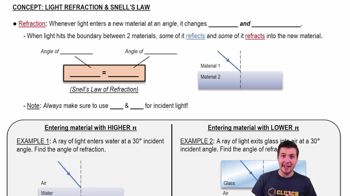
Snell's Law

Snell's Law describes how light bends when it passes from one medium to another. It is expressed as n1 * sin(θ1) = n2 * sin(θ2), where n1 and n2 are the refractive indices of the two media, and θ1 and θ2 are the angles of incidence and refraction, respectively. This law is crucial for calculating the angle of refraction when light enters a new medium.
Recommended video:

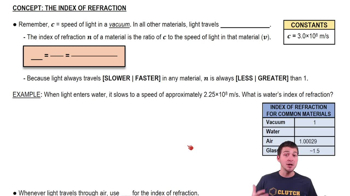
Refractive Index

The refractive index of a material is a measure of how much it reduces the speed of light compared to its speed in a vacuum. It is a dimensionless number that indicates how much light bends when entering the material. A higher refractive index means greater bending of light. Understanding refractive indices is essential for solving problems involving light transition between different media.
Recommended video:
Guided course
03:46
Index of Refraction

Angle of Incidence and Refraction

The angle of incidence is the angle between the incoming light ray and the normal to the surface at the point of entry. The angle of refraction is the angle between the refracted ray and the normal. These angles are key in applying Snell's Law to determine how light will behave as it moves from one medium to another, such as from air to glass or methanol.
Recommended video:
Guided course
03:46
Index of Refraction