Ch 27: Magnetic Field and Magnetic Forces
Young & Freedman Calc - University Physics 15th Edition
Young & Freedman Calc15th EditionUniversity PhysicsISBN: 9780135159552Not the one you use?Change textbook
Chapter 27, Problem 4

A particle with mass 1.81×1031.81\(\times\)10^{-3} kg\(\operatorname{kg}\) and a charge of 1.22×10⁸ C1.22\(\times\)10^{-8}\(\text{ C}\) has, at a given instant, a velocity v=(3.00×10⁴ m/s)jv=(3.00\(\times\)10^4\(\text{ m/s}\))\(\mathbf{j}\). What are the magnitude and direction of the particle's acceleration produced by a uniform magnetic field B=(1.63T)i+(0.980T)jB=(1.63T)\(\mathbf{i}\)+(0.980T)\(\mathbf{j}\)?

Verified step by step guidance
1
Identify the relevant formula for the force on a charged particle moving in a magnetic field, which is given by the Lorentz force equation: F = q(v × B), where q is the charge, v is the velocity, and B is the magnetic field.
Calculate the cross product v × B. Given v = (3.00×10^4 m/s)j and B = (1.63 T)i + (0.980 T)j, use the determinant method to find the cross product: v × B = |i j k| |0 3.00×10^4 0| |1.63 0.980 0|.
Evaluate the determinant to find the components of the cross product. The result will be a vector that represents the magnetic force direction.
Use the magnitude of the force from the cross product to find the acceleration. The magnitude of the force is given by F = q|v × B|. Use Newton's second law, F = ma, to solve for the acceleration: a = F/m.
Determine the direction of the acceleration. Since the force is perpendicular to both the velocity and the magnetic field, use the right-hand rule to find the direction of the force, and hence the direction of the acceleration.

Verified video answer for a similar problem:

This video solution was recommended by our tutors as helpful for the problem above.
Video duration:
4m
Was this helpful?

Key Concepts

Here are the essential concepts you must grasp in order to answer the question correctly.

Lorentz Force

The Lorentz force is the force exerted on a charged particle moving through a magnetic field. It is given by the equation F = q(v × B), where q is the charge, v is the velocity, and B is the magnetic field. This force is perpendicular to both the velocity of the particle and the magnetic field, affecting the particle's trajectory without changing its speed.
Recommended video:
Guided course
13:39
Lorentz Transformations of Velocity

Cross Product

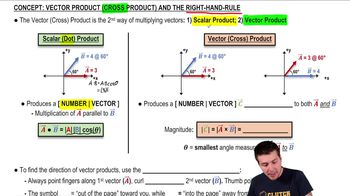
The cross product is a mathematical operation used to find a vector perpendicular to two given vectors. In the context of the Lorentz force, the cross product of the velocity vector v and the magnetic field vector B determines the direction of the force acting on the particle. The magnitude of the cross product is given by |v||B|sin(θ), where θ is the angle between v and B.
Recommended video:
Guided course
10:30
Vector (Cross) Product and the Right-Hand-Rule

Acceleration

Acceleration is the rate of change of velocity of an object. In this scenario, the acceleration of the particle is determined by the Lorentz force acting on it, using Newton's second law, F = ma, where m is the mass of the particle. The direction of acceleration is the same as the direction of the Lorentz force, which is perpendicular to both the velocity and the magnetic field.
Recommended video:
Guided course
05:47
Intro to Acceleration