A flat, square surface with side length is in the xy-plane at . Calculate the magnitude of the flux through this surface produced by a magnetic field .
Ch 27: Magnetic Field and Magnetic Forces
Young & Freedman Calc15th EditionUniversity PhysicsISBN: 9780135159552Not the one you use?Change textbook
Chapter 27, Problem 9b
A circular area with a radius of 6.50 cm lies in the xy-plane. What is the magnitude of the magnetic flux through this circle due to a uniform magnetic field B = 0.230 T at an angle of 53.1° from the +z-direction?
Verified step by step guidance1
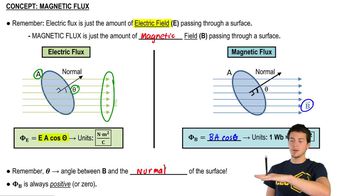
First, understand that magnetic flux (Φ) through a surface is given by the formula: Φ = B * A * cos(θ), where B is the magnetic field, A is the area of the surface, and θ is the angle between the magnetic field and the normal to the surface.
Calculate the area (A) of the circular region. The formula for the area of a circle is A = π * r^2, where r is the radius. Convert the radius from centimeters to meters by dividing by 100, since 1 cm = 0.01 m.
Substitute the given radius (6.50 cm) into the area formula to find A in square meters.
Identify the angle θ. The problem states that the magnetic field is at an angle of 53.1° from the +z-direction. Since the circle lies in the xy-plane, the normal to the surface is along the z-axis. Therefore, θ is the angle between the magnetic field and the normal, which is 53.1°.
Substitute the values of B (0.230 T), A (calculated area), and θ (53.1°) into the magnetic flux formula Φ = B * A * cos(θ) to find the magnitude of the magnetic flux through the circle.

Verified video answer for a similar problem:
This video solution was recommended by our tutors as helpful for the problem above.
Video duration:
3mWas this helpful?
Key Concepts
Here are the essential concepts you must grasp in order to answer the question correctly.
Magnetic Flux
Magnetic flux quantifies the amount of magnetic field passing through a given area. It is calculated as the product of the magnetic field strength, the area it penetrates, and the cosine of the angle between the field and the normal to the surface. This concept is crucial for understanding how magnetic fields interact with surfaces.
Recommended video:
Guided course
Magnetic Flux
Dot Product
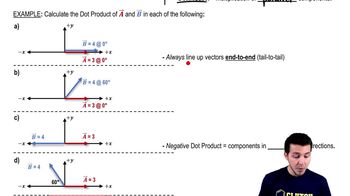
The dot product is a mathematical operation that multiplies two vectors and returns a scalar. It is used to calculate the component of one vector along the direction of another. In the context of magnetic flux, it helps determine the effective magnetic field passing through a surface by considering the angle between the field and the surface normal.
Recommended video:
Guided course
Introduction to Dot Product (Scalar Product)
Trigonometry in Physics
Trigonometry is essential in physics for resolving vector components and calculating angles. In this problem, the cosine function is used to find the component of the magnetic field perpendicular to the circular area. Understanding trigonometric relationships allows for accurate calculations of physical quantities like magnetic flux.
Recommended video:
Guided course
Trigonometry
Related Practice
Textbook Question
1
views
Textbook Question
An open plastic soda bottle with an opening diameter of 2.5 cm is placed on a table. A uniform 1.75 T magnetic field directed upward and oriented 25° from vertical encompasses the bottle. What is the total magnetic flux through the plastic of the soda bottle?
12
views
Textbook Question
A particle with mass and a charge of has, at a given instant, a velocity . What are the magnitude and direction of the particle's acceleration produced by a uniform magnetic field ?
1
views
Textbook Question
A horizontal rectangular surface has dimensions 2.80 cm by 3.20 cm and is in a uniform magnetic field that is directed at an angle of 30.0° above the horizontal. What must the magnitude of the magnetic field be to produce a flux of 3.10 x 10⁻⁴ Wb through the surface?