
Ch 26: Direct-Current Circuits
Young & Freedman Calc - University Physics 15th Edition
Young & Freedman Calc15th EditionUniversity PhysicsISBN: 9780135159552Not the one you use?Change textbook
Chapter 26, Problem 43

An emf source with ε = 120V, a resistor with R = 80.0Ω, and a capacitor with C = 4.00 μF are connected in series. As the capacitor charges, when the current in the resistor is 0.900 A, what is the magnitude of the charge on each plate of the capacitor?

Verified step by step guidance
1
Identify the given values: the emf source ε = 120V, the resistor R = 80.0Ω, the capacitor C = 4.00 μF, and the current I = 0.900 A.
Use Ohm's Law to find the voltage across the resistor: V_R = I * R. Substitute the given values to find V_R.
Calculate the voltage across the capacitor using the formula V_C = ε - V_R, where ε is the emf of the source.
Use the formula for the charge on a capacitor: Q = C * V_C, where C is the capacitance and V_C is the voltage across the capacitor.
Substitute the values for C and V_C into the formula to find the magnitude of the charge Q on each plate of the capacitor.

Verified video answer for a similar problem:

This video solution was recommended by our tutors as helpful for the problem above.
Video duration:
2m
Was this helpful?

Key Concepts

Here are the essential concepts you must grasp in order to answer the question correctly.

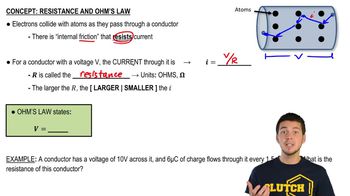
Ohm's Law

Ohm's Law is a fundamental principle in electronics and physics that states the current (I) through a conductor between two points is directly proportional to the voltage (V) across the two points and inversely proportional to the resistance (R) of the conductor. It is mathematically expressed as V = IR. This law is crucial for calculating the voltage drop across the resistor in the circuit.
Recommended video:
Guided course
03:07
Resistance and Ohm's Law

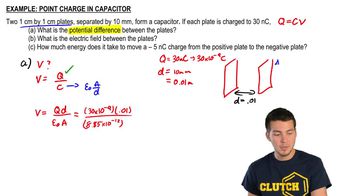
Capacitor Charging

When a capacitor charges in a circuit, it stores electrical energy in the form of an electric field. The charge (Q) on a capacitor is related to its capacitance (C) and the voltage (V) across it by the equation Q = CV. As the capacitor charges, the current decreases exponentially, and the voltage across the capacitor increases until it equals the source voltage.
Recommended video:
Guided course
06:07
Point Charge Inside Capacitor

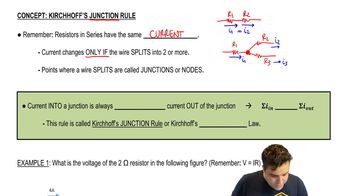
Kirchhoff's Voltage Law

Kirchhoff's Voltage Law (KVL) states that the sum of the electrical potential differences (voltage) around any closed network is zero. In a series circuit, this means the sum of the voltage drops across the resistor and the capacitor must equal the emf of the source. This principle helps in determining the voltage across the capacitor when the current is known.
Recommended video:
Guided course
04:08
Kirchhoff's Junction Rule