

When a resistor with resistance is connected to a -V flashlight battery, the resistor consumes W of electrical power. (Throughout, assume that each battery has negligible internal resistance.) What power does the resistor consume if it is connected to a -V car battery? Assume that remains constant when the power consumption changes.
Ch 25: Current, Resistance, and EMF
Young & Freedman Calc15th EditionUniversity PhysicsISBN: 9780135159552Not the one you use?Change textbook
Chapter 25, Problem 31a
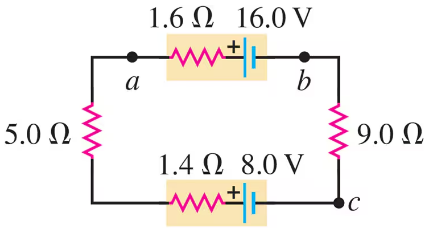
The circuit shown in Fig. E contains two batteries, each with an emf and an internal resistance, and two resistors. Find the current in the circuit (magnitude and direction).

Verified step by step guidance1
Identify the components in the circuit: two batteries with emfs of 9.5 V and 4.5 V, internal resistances of 1.8 Ω and 1.2 Ω, and two external resistors of 6.5 Ω and 5.5 Ω.
Apply Kirchhoff's loop rule to the circuit. Start at one point in the loop and move around the circuit, adding the potential differences across each component. The sum of the potential differences in a closed loop is zero.
Write the equation for the loop: 9.5 V - I(1.8 Ω) - I(6.5 Ω) - 4.5 V - I(1.2 Ω) - I(5.5 Ω) = 0, where I is the current in the circuit.
Combine the terms to simplify the equation: 9.5 V - 4.5 V - I(1.8 Ω + 6.5 Ω + 1.2 Ω + 5.5 Ω) = 0.
Solve for the current I by isolating it on one side of the equation: I = (9.5 V - 4.5 V) / (1.8 Ω + 6.5 Ω + 1.2 Ω + 5.5 Ω). This will give you the magnitude of the current. The direction of the current is determined by the direction of the net emf, which is from the 9.5 V battery to the 4.5 V battery.

Verified video answer for a similar problem:
This video solution was recommended by our tutors as helpful for the problem above.
Video duration:
5mWas this helpful?
Key Concepts
Here are the essential concepts you must grasp in order to answer the question correctly.
Kirchhoff's Loop Rule
Kirchhoff's Loop Rule states that the sum of the electromotive forces (emfs) and potential differences (voltage drops) around any closed loop in a circuit must equal zero. This principle is essential for analyzing circuits with multiple loops and components, allowing us to set up equations to solve for unknown quantities like current. In the given circuit, applying this rule helps determine the current by accounting for the emfs and resistances present.
Recommended video:
Intro to Kirchhoff's Loop Rule
Ohm's Law
Ohm's Law is a fundamental principle in electronics that relates voltage (V), current (I), and resistance (R) in a circuit through the equation V = IR. This law is crucial for calculating the voltage drop across resistors and understanding how current flows through the circuit. In the context of the given circuit, Ohm's Law helps determine the current by considering the total resistance and the net voltage provided by the batteries.
Recommended video:
Guided course
Resistance and Ohm's Law
Internal Resistance of Batteries
Internal resistance is the inherent resistance within a battery that affects its ability to deliver current. It causes a voltage drop inside the battery, reducing the effective voltage available to the external circuit. Understanding internal resistance is vital for accurately calculating the current in circuits with batteries, as it impacts the total resistance and the net voltage applied. In the given circuit, each battery's internal resistance must be considered to find the correct current magnitude and direction.
Recommended video:
Guided course
Total Internal Energy
Related Practice
Textbook Question
1
views
Textbook Question
The circuit shown in Fig. E contains two batteries, each with an emf and an internal resistance, and two resistors. Find the terminal voltage of the -V battery.
21
views
Textbook Question
The circuit shown in Fig. E contains two batteries, each with an emf and an internal resistance, and two resistors. Find the potential difference of point with respect to point .
1
views
Textbook Question
An idealized ammeter is connected to a battery as shown in Fig. E. Find the terminal voltage of the battery.
2
views
Textbook Question
Consider the circuit of Fig. E25.30. What is the total rate at which electrical energy is dissipated in the 5.0 Ω and 9.0 Ω resistors?
1
views
Textbook Question
An idealized ammeter is connected to a battery as shown in Fig. E. Find the current through the - resistor.
1
views
