
Ch 24: Capacitance and Dielectrics
Young & Freedman Calc - University Physics 15th Edition
Young & Freedman Calc15th EditionUniversity PhysicsISBN: 9780135159552Not the one you use?Change textbook
Chapter 24, Problem 41

When a 360360-nF air capacitor (11 nF = 10910^{-9} F) is connected to a power supply, the energy stored in the capacitor is 1.85x1051.85x10^{-5} J. While the capacitor is kept connected to the power supply, a slab of dielectric is inserted that completely fills the space between the plates. This increases the stored energy by 2.32×1052.32\(\times\)10^{-5} J.
(a) What is the potential difference between the capacitor plates?
(b) What is the dielectric constant of the slab?

Verified step by step guidance
1
First, understand that the energy stored in a capacitor is given by the formula: \( U = \frac{1}{2} C V^2 \), where \( U \) is the energy, \( C \) is the capacitance, and \( V \) is the potential difference. We need to find \( V \) using the initial energy and capacitance.
Rearrange the formula to solve for \( V \): \( V = \sqrt{\frac{2U}{C}} \). Substitute the given values: \( U = 1.85 \times 10^{-5} \) J and \( C = 360 \times 10^{-9} \) F.
Calculate the potential difference \( V \) using the rearranged formula. This will give you the potential difference between the capacitor plates before the dielectric is inserted.
Next, to find the dielectric constant \( \kappa \), use the fact that the energy stored in the capacitor with the dielectric is \( U' = \kappa U \). The new energy is given as \( 1.85 \times 10^{-5} \) J + \( 2.32 \times 10^{-5} \) J.
Solve for the dielectric constant \( \kappa \) using the equation \( \kappa = \frac{U'}{U} \), where \( U' \) is the total energy with the dielectric and \( U \) is the initial energy. Substitute the known values to find \( \kappa \).

Verified video answer for a similar problem:

This video solution was recommended by our tutors as helpful for the problem above.
Video duration:
5m
Was this helpful?

Key Concepts

Here are the essential concepts you must grasp in order to answer the question correctly.

Capacitance and Energy Storage

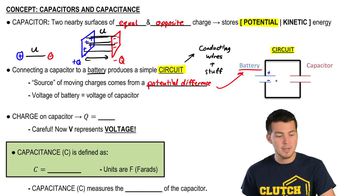
Capacitance is the ability of a capacitor to store charge per unit voltage, measured in farads (F). The energy stored in a capacitor is given by the formula E = 0.5 * C * V^2, where E is energy, C is capacitance, and V is the potential difference. Understanding this relationship helps determine the potential difference when the energy and capacitance are known.
Recommended video:
Guided course
08:02
Capacitors & Capacitance (Intro)

Dielectric Materials

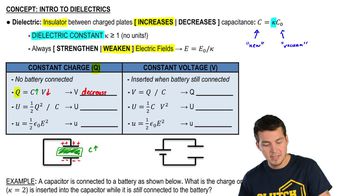
Dielectric materials are insulators that increase a capacitor's ability to store charge when placed between its plates. They are characterized by a dielectric constant (k), which quantifies how much the capacitance increases compared to when the capacitor is empty. The dielectric constant is crucial for calculating changes in stored energy and capacitance when a dielectric is introduced.
Recommended video:
Guided course
06:25
Intro To Dielectrics

Potential Difference

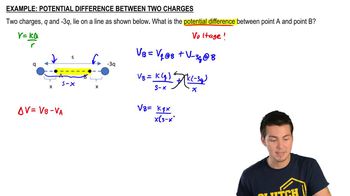
Potential difference, or voltage, across capacitor plates is the work done per unit charge to move a charge between the plates. It is a key factor in determining the energy stored in a capacitor. In this problem, calculating the potential difference involves using the initial energy and capacitance values before the dielectric is inserted.
Recommended video:
Guided course
07:04
Potential Difference Between Two Charges
Related Practice
Textbook Question

A parallel-plate capacitor has capacitance C0=8.00C_0=8.00 pF when there is air between the plates. The separation between the plates is 1.501.50 mm.

(a) What is the maximum magnitude of charge QQ that can be placed on each plate if the electric field in the region between the plates is not to exceed 3.00×1043.00\(\times\)10^4 V/m?

(b) A dielectric with K=2.70K = 2.70 is inserted between the plates of the capacitor, completely filling the volume between the plates. Now what is the maximum magnitude of charge on each plate if the electric field between the plates is not to exceed 3.00×1043.00\(\times\)10^4 V/m?

8
views
Textbook Question

A constant potential difference of 1212 V is maintained between the terminals of a 0.250.25-μ\(\mu\)F, parallel-plate, air capacitor.

(a) A sheet of Mylar is inserted between the plates of the capacitor, completely filling the space between the plates. When this is done, how much additional charge flows onto the positive plate of the capacitor (see Table 24.124.1)?

(b) What is the total induced charge on either face of the Mylar sheet?

(c) What effect does the Mylar sheet have on the electric field between the plates? Explain how you can reconcile this with the increase in charge on the plates, which acts to increase the electric field.

1
views
Textbook Question

Polystyrene has dielectric constant 2.62.6 and dielectric strength 2.0×1072.0\(\times\)10^7 V/m. A piece of polystyrene is used as a dielectric in a parallel-plate capacitor, filling the volume between the plates.

(a) When the electric field between the plates is 8080%% of the dielectric strength, what is the energy density of the stored?

(b) When the capacitor is connected to a battery with voltage 500.0500.0 V, the electric field between the plates is 80%80\% of the dielectric strength. What is the area of each plate if the capacitor stores 0.2000.200 mJ of energy under these conditions?

2
views