
Ch 24: Capacitance and Dielectrics
Young & Freedman Calc - University Physics 15th Edition
Young & Freedman Calc15th EditionUniversity PhysicsISBN: 9780135159552Not the one you use?Change textbook
Chapter 24, Problem 1

The plates of a parallel-plate capacitor are 2.502.50 mm apart, and each carries a charge of magnitude 80.080.0 nC. The plates are in vacuum. The electric field between the plates has a magnitude of 4.00×1064.00\(\times\)10^6 V/m. What is (a) the potential difference between the plates; (b) the area of each plate; (c) the capacitance?

Verified step by step guidance
1
To find the potential difference (V) between the plates, use the formula for the electric field (E) in a parallel-plate capacitor: E = V/d, where d is the separation between the plates. Rearrange the formula to solve for V: V = E * d. Substitute E = 4.00x10^6 V/m and d = 2.50 mm (convert to meters) into the equation.
To find the area (A) of each plate, use the formula for the electric field in terms of charge (Q) and area: E = Q/(ε₀ * A), where ε₀ is the permittivity of free space (8.85x10^-12 C²/N·m²). Rearrange the formula to solve for A: A = Q/(ε₀ * E). Substitute Q = 80.0 nC (convert to coulombs) and E = 4.00x10^6 V/m into the equation.
To find the capacitance (C) of the capacitor, use the formula C = Q/V, where Q is the charge on the plates and V is the potential difference. Substitute the values of Q and V obtained from previous steps into the equation.
Ensure all units are consistent when performing calculations. Convert nanocoulombs to coulombs and millimeters to meters where necessary.
Review the relationships between electric field, potential difference, charge, area, and capacitance to understand how each quantity affects the others in a parallel-plate capacitor.

Verified video answer for a similar problem:

This video solution was recommended by our tutors as helpful for the problem above.
Video duration:
7m
Was this helpful?

Key Concepts

Here are the essential concepts you must grasp in order to answer the question correctly.

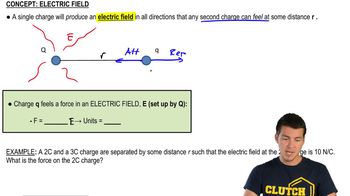
Electric Field

The electric field is a vector field around charged objects, representing the force exerted per unit charge. In a parallel-plate capacitor, the electric field is uniform and can be calculated using the formula E = V/d, where E is the electric field, V is the potential difference, and d is the separation between the plates.
Recommended video:
Guided course
03:16
Intro to Electric Fields

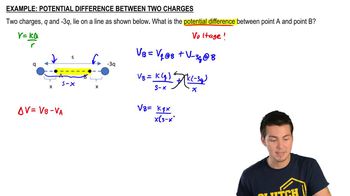
Potential Difference

Potential difference, or voltage, is the work done to move a unit charge between two points in an electric field. For a parallel-plate capacitor, it can be calculated using the formula V = E * d, where E is the electric field and d is the distance between the plates. It represents the energy per unit charge stored in the capacitor.
Recommended video:
Guided course
07:04
Potential Difference Between Two Charges

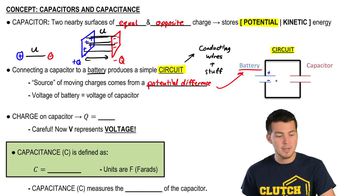
Capacitance

Capacitance is the ability of a system to store charge per unit voltage, defined as C = Q/V, where Q is the charge and V is the potential difference. For a parallel-plate capacitor, it can also be calculated using C = ε₀ * A/d, where ε₀ is the permittivity of free space, A is the area of the plates, and d is the separation between them.
Recommended video:
Guided course
08:02
Capacitors & Capacitance (Intro)