
Ch 23: Electric Potential
Young & Freedman Calc - University Physics 15th Edition
Young & Freedman Calc15th EditionUniversity PhysicsISBN: 9780135159552Not the one you use?Change textbook
Chapter 23, Problem 32b

An infinitely long line of charge has linear charge den­sity 5.00×10125.00\(\times\)10^{-12} C/m. A proton (mass 1.67×10271.67\(\times\)10^{-27} kg, charge +1.60×10¹⁹+1.60\(\times\)10^{-19} C) is 18.018.0 cm from the line and moving directly toward the line at 3.50×1033.50\(\times\)10^3 m/s. How close does the proton get to the line of charge?

Verified step by step guidance
1
First, understand that the electric field (E) due to an infinitely long line of charge with linear charge density (λ) is given by the formula: E = (2 * k * λ) / r, where k is Coulomb's constant (8.99 x 10^9 N m²/C²) and r is the distance from the line of charge.
Next, calculate the initial electric potential energy (U_i) of the proton when it is 18.0 cm (0.18 m) from the line of charge. The potential energy is given by U = q * V, where V is the electric potential due to the line of charge. The potential V at a distance r from the line is V = (2 * k * λ) * ln(r).
Determine the initial kinetic energy (K_i) of the proton using the formula K = (1/2) * m * v², where m is the mass of the proton and v is its initial velocity.
Apply the conservation of energy principle, which states that the total mechanical energy (sum of kinetic and potential energy) remains constant. Set up the equation: K_i + U_i = K_f + U_f, where K_f and U_f are the final kinetic and potential energies when the proton is at its closest distance to the line.
Solve for the closest distance (r_f) by setting the final kinetic energy (K_f) to zero (since the proton momentarily stops at the closest point) and rearranging the conservation of energy equation to find r_f. This involves solving the equation: (1/2) * m * v² + q * (2 * k * λ) * ln(0.18) = q * (2 * k * λ) * ln(r_f).

Verified video answer for a similar problem:

This video solution was recommended by our tutors as helpful for the problem above.
Video duration:
7m
Was this helpful?

Key Concepts

Here are the essential concepts you must grasp in order to answer the question correctly.

Electric Field of a Line Charge

An infinitely long line of charge creates an electric field that decreases with distance from the line. The electric field (E) at a distance (r) from the line is given by E = λ/(2πε₀r), where λ is the linear charge density and ε₀ is the permittivity of free space. This field influences the motion of charged particles nearby.
Recommended video:
Guided course
08:20
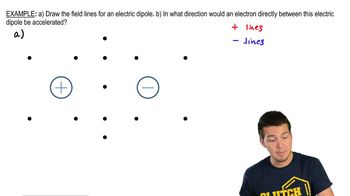
Electric Field Lines

Kinetic and Potential Energy in Electric Fields

A charged particle in an electric field experiences changes in kinetic and potential energy. As the proton moves toward the line of charge, its kinetic energy decreases while its electric potential energy increases. The conservation of energy principle allows us to calculate the closest approach by equating initial kinetic energy with the change in potential energy.
Recommended video:
Guided course
07:51
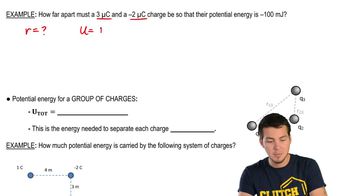
Electric Potential Energy

Conservation of Energy

The conservation of energy states that the total energy of an isolated system remains constant. For the proton, the sum of its kinetic and potential energy at any point in its motion is constant. By applying this principle, we can determine the point where the proton's kinetic energy is zero, indicating its closest approach to the line of charge.
Recommended video:
Guided course
06:24
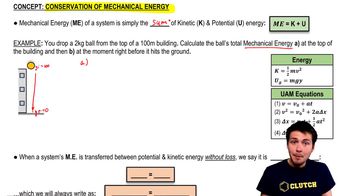
Conservation Of Mechanical Energy
Related Practice
Textbook Question

A very long insulating cylinder of charge of radius 2.502.50 cm carries a uniform linear density of 15.015.0 nC/m. If you put one probe of a voltmeter at the surface, how far from the surface must the other probe be placed so that the voltmeter reads 175175 V?

12
views
Textbook Question

Two large, parallel conducting plates carrying op­posite charges of equal magnitude are separated by 2.202.20 cm. If the surface charge density for each plate has magnitude 47.047.0 nC/m2, what is the magnitude of EE in the region between the plates?

2
views
Textbook Question

A thin spherical shell with radius R1=3.00R_1 = 3.00 cm is concentric with a larger thin spherical shell with radius R2=5.00R_2 = 5.00 cm. Both shells are made of insulating material. The smaller shell has charge q1=+6.00q_1 = +6.00 nC distributed uniformly over its surface, and the larger shell has charge q2=9.00q_2 = -9.00 nC distributed uniformly over its surface. Take the electric potential to be zero at an infinite distance from both shells. What is the electric potential due to the two shells at the following distance from their common center: (i) r=0 r=0; (ii) r=4.00r=4.00 cm; (iii) r=6.00r=6.00 cm?

1
views
Textbook Question

An infinitely long line of charge has linear charge den­sity 5.00×10125.00\(\times\)10^{-12} C/m. A proton (mass 1.67×10271.67\(\times\)10^{-27} kg, charge +1.60×10¹⁹+1.60\(\times\)10^{-19} C) is 18.018.0 cm from the line and moving directly toward the line at 3.50×1033.50\(\times\)10^3 m/s. Calculate the proton's initial kinetic energy.

Textbook Question

Two large, parallel conducting plates carrying op­posite charges of equal magnitude are separated by 2.202.20 cm. What is the potential difference between the two plates?

Textbook Question

At a certain distance from a point charge, the potential and electric-field magnitude due to that charge are 4.984.98 V and 16.216.2 V/m, respectively. (Take V=0V = 0 at infinity.) Is the electric field directed toward or away from the point charge?