
Two large, parallel conducting plates carrying opposite charges of equal magnitude are separated by cm. If the surface charge density for each plate has magnitude nC/m2, what is the magnitude of in the region between the plates?
A very long insulating cylinder of charge of radius cm carries a uniform linear density of nC/m. If you put one probe of a voltmeter at the surface, how far from the surface must the other probe be placed so that the voltmeter reads V?
Verified step by step guidance
Verified video answer for a similar problem:
Key Concepts
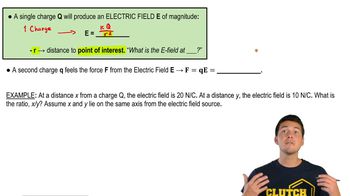
Electric Field of a Charged Cylinder
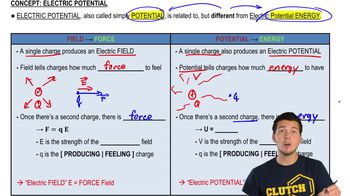
Electric Potential Difference
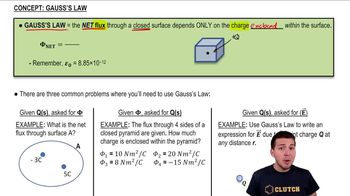
Gauss's Law
A thin spherical shell with radius cm is concentric with a larger thin spherical shell with radius cm. Both shells are made of insulating material. The smaller shell has charge nC distributed uniformly over its surface, and the larger shell has charge nC distributed uniformly over its surface. Take the electric potential to be zero at an infinite distance from both shells. What is the electric potential due to the two shells at the following distance from their common center: (i) ; (ii) cm; (iii) cm?
An infinitely long line of charge has linear charge density C/m. A proton (mass kg, charge C) is cm from the line and moving directly toward the line at m/s. Calculate the proton's initial kinetic energy.
Two large, parallel conducting plates carrying opposite charges of equal magnitude are separated by cm. What is the potential difference between the two plates?
Two large, parallel conducting plates carrying opposite charges of equal magnitude are separated by cm. The surface charge density for each plate has magnitude nC/m^2. If the separation between the plates is doubled while the surface charge density is kept constant at the given value, what happens to the magnitude of the electric field and to the potential difference?
An infinitely long line of charge has linear charge density C/m. A proton (mass kg, charge C) is cm from the line and moving directly toward the line at m/s. How close does the proton get to the line of charge?
