
Ch 22: Gauss' Law
Young & Freedman Calc - University Physics 15th Edition
Young & Freedman Calc15th EditionUniversity PhysicsISBN: 9780135159552Not the one you use?Change textbook
Chapter 22, Problem 3

You measure an electric field of 1.25×1061.25\(\times\)10^6 N/C at a distance of 0.1500.150 m from a point charge. There is no other source of electric field in the region other than this point charge.
(a) What is the electric flux through the surface of a sphere that has this charge at its center and that has radius 0.1500.150 m?
(b) What is the magnitude of this charge?

Verified step by step guidance
1
To solve part (a), recall that the electric flux (Φ) through a closed surface is given by Gauss's Law: Φ = ∮E·dA = Q_enc/ε₀, where E is the electric field, dA is the differential area vector, Q_enc is the enclosed charge, and ε₀ is the permittivity of free space.
Since the electric field is uniform over the surface of the sphere and radial, the flux can be simplified to Φ = E * A, where A is the surface area of the sphere. The surface area of a sphere is A = 4πr², where r is the radius of the sphere.
Substitute the given values into the formula for the surface area: A = 4π(0.150 m)².
Now, calculate the electric flux using Φ = E * A, where E = 1.25×10⁶ N/C and A is the surface area calculated in the previous step.
For part (b), use Gauss's Law to find the magnitude of the charge. Rearrange the formula to solve for Q_enc: Q_enc = Φ * ε₀. Substitute the value of the electric flux from part (a) and the known value of ε₀ (approximately 8.85×10⁻¹² C²/N·m²) to find the charge.

Verified video answer for a similar problem:

This video solution was recommended by our tutors as helpful for the problem above.
Video duration:
4m
Was this helpful?

Key Concepts

Here are the essential concepts you must grasp in order to answer the question correctly.

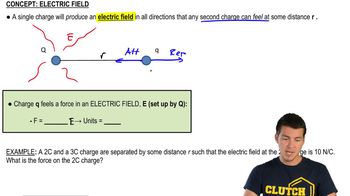
Electric Field

An electric field is a region around a charged particle where a force would be exerted on other charged particles. It is represented by the vector quantity E, measured in newtons per coulomb (N/C). The field's strength and direction depend on the magnitude and sign of the charge creating it, and it diminishes with distance from the charge.
Recommended video:
Guided course
03:16
Intro to Electric Fields

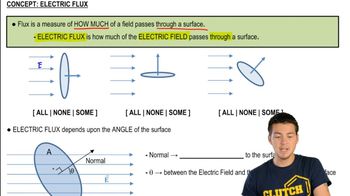
Electric Flux

Electric flux quantifies the amount of electric field passing through a given surface. It is calculated as the product of the electric field and the area perpendicular to the field lines, expressed in units of newton-meters squared per coulomb (N·m²/C). For a sphere surrounding a point charge, the flux is determined using Gauss's Law, which relates the flux to the enclosed charge.
Recommended video:
Guided course
05:43
Electric Flux

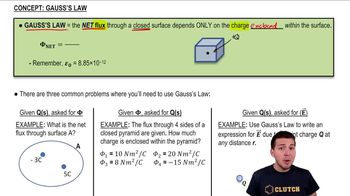
Gauss's Law

Gauss's Law states that the electric flux through a closed surface is proportional to the charge enclosed by the surface. Mathematically, it is expressed as Φ = Q/ε₀, where Φ is the electric flux, Q is the enclosed charge, and ε₀ is the permittivity of free space. This principle is crucial for calculating the electric flux and charge magnitude in symmetrical situations like a sphere surrounding a point charge.
Recommended video:
Related Practice