

Ch 22: Gauss' Law
Young & Freedman Calc - University Physics 15th Edition
Young & Freedman Calc15th EditionUniversity PhysicsISBN: 9780135159552Not the one you use?Change textbook
Chapter 22, Problem 1ab

A flat sheet of paper of area 0.2500.250 m2 is oriented so that the normal to the sheet is at an angle of 6060° to a uniform electric field of magnitude 1414 N/C.
(a) Find the magnitude of the electric flux through the sheet.
(b) Does the answer to part (a) depend on the shape of the sheet? Why or why not?

Verified step by step guidance
1
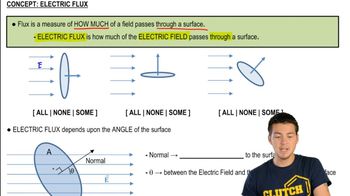
Step 1: Understand the concept of electric flux. Electric flux (Φ) through a surface is defined as the product of the electric field (E) and the area (A) of the surface, and the cosine of the angle (θ) between the field and the normal to the surface. The formula is Φ = E * A * cos(θ).
Step 2: Identify the given values from the problem. The electric field (E) is 14 N/C, the area (A) of the sheet is 0.250 m², and the angle (θ) between the normal to the sheet and the electric field is 60°.
Step 3: Calculate the cosine of the angle. Use the trigonometric function to find cos(60°), which is 0.5.
Step 4: Substitute the values into the electric flux formula. Plug in E = 14 N/C, A = 0.250 m², and cos(60°) = 0.5 into the formula Φ = E * A * cos(θ) to find the magnitude of the electric flux.
Step 5: Consider part (b) of the problem. The electric flux depends only on the area, the electric field, and the angle between them, not on the shape of the sheet. Therefore, the answer to part (a) does not depend on the shape of the sheet.

Verified video answer for a similar problem:

This video solution was recommended by our tutors as helpful for the problem above.
Video duration:
5m
Was this helpful?

Key Concepts

Here are the essential concepts you must grasp in order to answer the question correctly.

Electric Flux

Electric flux is a measure of the electric field passing through a given area. It is calculated as the product of the electric field magnitude, the area through which the field lines pass, and the cosine of the angle between the field and the normal to the surface. This concept helps quantify how much of the field penetrates the surface.
Recommended video:
Guided course
05:43
Electric Flux

Angle of Incidence

The angle of incidence in this context refers to the angle between the normal to the surface and the direction of the electric field. It is crucial for calculating electric flux, as the cosine of this angle determines how much of the field is effectively passing through the surface. A 60° angle means the field is not perpendicular, reducing the effective flux.
Recommended video:
Guided course
01:04
Critical Angle

Independence from Shape

The electric flux through a surface depends on the area and orientation relative to the electric field, not the shape of the surface. Whether the sheet is flat, curved, or any other shape, as long as the area and orientation remain constant, the flux calculation remains unchanged. This principle highlights the geometric nature of flux calculations.
Recommended video:
Guided course
18:29
Pressure Gauges: U-Shaped Tube