

Ch 22: Gauss' Law
Young & Freedman Calc - University Physics 15th Edition
Young & Freedman Calc15th EditionUniversity PhysicsISBN: 9780135159552Not the one you use?Change textbook
Chapter 22, Problem 27b

An infinitely long cylindrical conductor has radius r r and uniform surface charge density σσ. In terms of σσ, what is the magnitude of the electric field produced by the charged cylinder at a distance r>Rr > R from its axis? Then, express the result in terms of λλ and show that the electric field outside the cylinder is the same as if all the charge were on the axis.

Verified step by step guidance
1
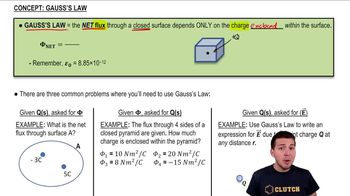
To find the electric field at a distance r > R from the axis of the cylinder, we use Gauss's Law. Gauss's Law states that the electric flux through a closed surface is equal to the charge enclosed divided by the permittivity of free space, \( \varepsilon_0 \).
Consider a cylindrical Gaussian surface of radius r and length L, coaxial with the charged cylinder. The electric field \( E \) is radial and constant over this surface, and the surface area of the cylindrical Gaussian surface is \( 2\pi r L \).
According to Gauss's Law, \( \Phi = E \cdot 2\pi r L = \frac{Q_{\text{enclosed}}}{\varepsilon_0} \). The charge enclosed by the Gaussian surface is \( Q_{\text{enclosed}} = \sigma \cdot 2\pi R L \), where \( \sigma \) is the surface charge density and \( R \) is the radius of the cylinder.
Substitute \( Q_{\text{enclosed}} \) into Gauss's Law: \( E \cdot 2\pi r L = \frac{\sigma \cdot 2\pi R L}{\varepsilon_0} \). Simplify to find the electric field: \( E = \frac{\sigma R}{\varepsilon_0 r} \).
To express the electric field in terms of linear charge density \( \lambda \), note that \( \lambda = \sigma \cdot 2\pi R \). Substitute \( \lambda \) into the expression for \( E \): \( E = \frac{\lambda}{2\pi \varepsilon_0 r} \). This shows that the electric field outside the cylinder is the same as if all the charge were concentrated along the axis.

Verified video answer for a similar problem:

This video solution was recommended by our tutors as helpful for the problem above.
Video duration:
4m
Was this helpful?

Key Concepts

Here are the essential concepts you must grasp in order to answer the question correctly.

Gauss's Law

Gauss's Law relates the electric flux through a closed surface to the charge enclosed by that surface. For a cylindrical conductor, it helps determine the electric field by considering a Gaussian surface coaxial with the cylinder. The symmetry of the problem simplifies calculations, as the electric field is uniform over the surface.
Recommended video:

Surface Charge Density

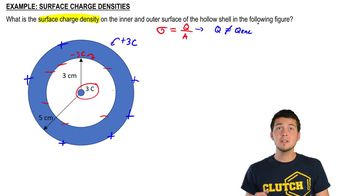
Surface charge density, denoted by σ, is the amount of charge per unit area on the surface of a conductor. It is crucial for calculating the total charge on the cylindrical surface, which is used in Gauss's Law to find the electric field. Understanding σ allows us to relate it to linear charge density λ for further analysis.
Recommended video:
Guided course
04:03
Surface Charge Density

Linear Charge Density

Linear charge density, λ, is the charge per unit length along a line, such as the axis of a cylinder. In this problem, it is used to express the electric field outside the cylinder, showing that the field behaves as if all the charge were concentrated along the axis. This simplification is possible due to the symmetry and infinite length of the cylinder.
Recommended video:
Guided course
8:13
Intro to Density
Related Practice
Textbook Question

A conductor with an inner cavity, like that shown in Fig. 22.2322.23c, carries a total charge of +5.00+5.00 nC. The charge within the cavity, insulated from the conductor, is 6.00−6.00 nC. How much charge is on (a) the inner surface of the conductor and (b) the outer surface of the conductor?

Textbook Question

Charge qq is distributed uniformly throughout the volume of an insulating sphere of radius R=4.00R = 4.00 cm. At a distance of r=8.00r = 8.00 cm from the center of the sphere, the electric field due to the charge distribution has magnitude E=940E = 940 N/C. What is the electric field at a distance of 2.002.00 cm from the sphere's center?

Textbook Question

A very long conducting tube (hollow cylinder) has inner radius AA and outer radius bb. It carries charge per unit length +α, where αα is a positive constant with units of C/m. A line of charge lies along the axis of the tube. The line of charge has charge per unit length. What is the charge per unit length on (i) the inner surface of the tube and (ii) the outer surface of the tube?

1
views
Textbook Question

An infinitely long cylindrical conductor has radius r r and uniform surface charge density σσ. In terms of σσ and RR, what is the charge per unit length λλ for the cylinder?

1
views
Textbook Question

A very long conducting tube (hollow cylinder) has inner radius AA and outer radius bb. It carries charge per unit length +α, where αα is a positive constant with units of C/m. A line of charge lies along the axis of the tube. The line of charge has charge per unit length. Calculate the electric field in terms of αα and the distance rr from the axis of the tube for (i) r<ar < a; (ii) a<r<ba < r < b; (iii) r>br > b. Show your results in a graph of EE as a function of RR.

1
views