
Ch 22: Gauss' Law
Young & Freedman Calc - University Physics 15th Edition
Young & Freedman Calc15th EditionUniversity PhysicsISBN: 9780135159552Not the one you use?Change textbook
Chapter 22, Problem 25

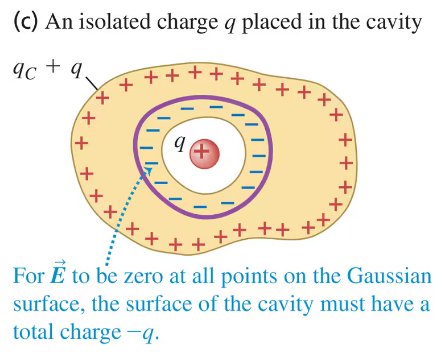
A conductor with an inner cavity, like that shown in Fig. 22.2322.23c, carries a total charge of +5.00+5.00 nC. The charge within the cavity, insulated from the conductor, is 6.00−6.00 nC. How much charge is on (a) the inner surface of the conductor and (b) the outer surface of the conductor?
Diagram of a conductor with cavity showing charge distribution and Gaussian surface with labeled charges.

Verified step by step guidance
1
Understand that the conductor is electrically neutral overall, meaning the total charge on the conductor itself must balance the charge within the cavity.
Recognize that the charge within the cavity is -6.00 nC. According to electrostatic principles, the inner surface of the conductor must have a charge that exactly cancels this charge to maintain electrostatic equilibrium. Therefore, the inner surface must have a charge of +6.00 nC.
Calculate the charge on the outer surface of the conductor. The conductor carries a total charge of +5.00 nC. Since the inner surface has a charge of +6.00 nC, the outer surface must have a charge that, when combined with the inner surface charge, equals the total charge of the conductor.
Use the equation: Qouter=Qtotal-Qinner, where Qtotal is the total charge on the conductor (+5.00 nC) and Qinner is the charge on the inner surface (+6.00 nC).
Substitute the known values into the equation to find the charge on the outer surface: Qouter=5.00-6.00 nC.

Verified video answer for a similar problem:

This video solution was recommended by our tutors as helpful for the problem above.
Video duration:
3m
Was this helpful?

Key Concepts

Here are the essential concepts you must grasp in order to answer the question correctly.

Gauss's Law

Gauss's Law relates the electric flux through a closed surface to the charge enclosed by that surface. It states that the total electric flux is proportional to the enclosed charge, allowing us to determine the distribution of charge on surfaces of conductors. In this scenario, it helps us understand how charges distribute themselves on the inner and outer surfaces of the conductor.
Recommended video:

Charge Conservation

Charge conservation is a fundamental principle stating that the total electric charge in an isolated system remains constant. In the context of the conductor with a cavity, the total charge of +5.00 nC must be distributed between the inner and outer surfaces, considering the charge within the cavity. This principle helps determine how charges are allocated on different surfaces.
Recommended video:
Guided course
05:43
Conservation of Charge

Conductors in Electrostatic Equilibrium

Conductors in electrostatic equilibrium have charges that reside on their surfaces, and the electric field inside the conductor is zero. This concept is crucial for understanding that the charge on the inner surface of the conductor will exactly counterbalance the charge within the cavity, ensuring no electric field exists within the conductor's material.
Recommended video:
Guided course
07:43
Electric Fields in Conductors
Related Practice
Textbook Question

Charge qq is distributed uniformly throughout the volume of an insulating sphere of radius R=4.00R = 4.00 cm. At a distance of r=8.00r = 8.00 cm from the center of the sphere, the electric field due to the charge distribution has magnitude E=940E = 940 N/C. What is the volume charge density for the sphere?

Textbook Question

A hollow, conducting sphere with an outer radius of 0.2500.250 m and an inner radius of 0.2000.200 m has a uniform surface charge density of +6.37×10⁶+6.37\(\times\)10^{-6} C/m2. A charge of 0.500−0.500 μ\(\mu\)C is now introduced at the center of the cavity inside the sphere. What is the electric flux through a spherical surface just inside the inner surface of the sphere?

Textbook Question

An infinitely long cylindrical conductor has radius r r and uniform surface charge density σσ. In terms of σσ, what is the magnitude of the electric field produced by the charged cylinder at a distance r>Rr > R from its axis? Then, express the result in terms of λλ and show that the electric field outside the cylinder is the same as if all the charge were on the axis.

Textbook Question

Charge qq is distributed uniformly throughout the volume of an insulating sphere of radius R=4.00R = 4.00 cm. At a distance of r=8.00r = 8.00 cm from the center of the sphere, the electric field due to the charge distribution has magnitude E=940E = 940 N/C. What is the electric field at a distance of 2.002.00 cm from the sphere's center?

Textbook Question

An infinitely long cylindrical conductor has radius r r and uniform surface charge density σσ. In terms of σσ and RR, what is the charge per unit length λλ for the cylinder?

1
views
Textbook Question

A very long conducting tube (hollow cylinder) has inner radius AA and outer radius bb. It carries charge per unit length +α, where αα is a positive constant with units of C/m. A line of charge lies along the axis of the tube. The line of charge has charge per unit length. Calculate the electric field in terms of αα and the distance rr from the axis of the tube for (i) r<ar < a; (ii) a<r<ba < r < b; (iii) r>br > b. Show your results in a graph of EE as a function of RR.

1
views