
A point charge is placed at each corner of a square with side length . All charges have magnitude . Two of the charges are positive and two are negative (Fig. E). What is the direction of the net electric field at the center of the square due to the four charges, and what is its magnitude in terms of and ?
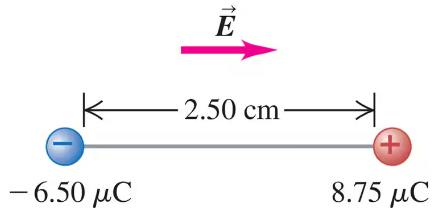
A -mC point charge is glued down on a horizontal frictionless table. It is tied to a -mC point charge by a light, nonconducting -cm wire. A uniform electric field of magnitude is directed parallel to the wire, as shown in Fig. E. What would the tension be if both charges were negative?

Verified step by step guidance
Verified video answer for a similar problem:
Key Concepts
Coulomb's Law
Electric Field
Tension in a Wire
A proton is traveling horizontally to the right at m/s. How much time does it take the proton to stop after entering the field?
A -nC point charge is at the origin, and a second -nC point charge is on the -axis at m. Find the electric field (magnitude and direction) at each of the following points on the -axis: (i) m; (ii) m; (iii) m.
A proton is traveling horizontally to the right at m/s. What minimum field (magnitude and direction) would be needed to stop an electron under the conditions of part (a)? Note: Part (a) asks for how much time does it take the proton to stop after entering the field.
A -mC point charge is glued down on a horizontal frictionless table. It is tied to a -mC point charge by a light, nonconducting -cm wire. A uniform electric field of magnitude is directed parallel to the wire, as shown in Fig. E. Find the tension in the wire.
A -nC point charge is at the origin, and a second -nC point charge is on the -axis at m. Find the net electric force that the two charges would exert on an electron placed at each point in part (a). Note: Part (a) asked to find the electric field (magnitude and direction) at each of the following points on the -axis: (i) m; (ii) m; (iii) m.
