Ch 21: Electric Charge and Electric Field
Young & Freedman Calc - University Physics 15th Edition
Young & Freedman Calc15th EditionUniversity PhysicsISBN: 9780135159552Not the one you use?Change textbook
Chapter 21, Problem 36a

A 4.00-4.00-nC point charge is at the origin, and a second 5.00-5.00-nC point charge is on the xx-axis at x=0.800x = 0.800 m. Find the electric field (magnitude and direction) at each of the following points on the xx-axis: (i) x=0.200x = 0.200 m; (ii) x=1.20x = 1.20 m; (iii) x=0.200x = -0.200 m.

Verified step by step guidance
1
Step 1: Understand the concept of electric field due to a point charge. The electric field \( E \) created by a point charge \( q \) at a distance \( r \) is given by \( E = \frac{k \cdot |q|}{r^2} \), where \( k \) is Coulomb's constant \( 8.99 \times 10^9 \text{ N m}^2/\text{C}^2 \). The direction of the electric field is away from the charge if it is positive and towards the charge if it is negative.
Step 2: Calculate the electric field at each specified point on the x-axis due to each charge separately. For point (i) at \( x = 0.200 \text{ m} \), calculate the electric field due to the charge at the origin and the charge at \( x = 0.800 \text{ m} \). Use the formula \( E = \frac{k \cdot |q|}{r^2} \) for each charge, considering the distance from the charge to the point.
Step 3: Determine the direction of the electric field at each point. Since both charges are negative, the electric field at any point will be directed towards each charge. Sum the electric fields vectorially, taking into account their directions, to find the net electric field at each point.
Step 4: Calculate the net electric force on an electron at each point using the formula \( F = q_e \cdot E_{net} \), where \( q_e \) is the charge of an electron \( -1.60 \times 10^{-19} \text{ C} \). Use the net electric field calculated in the previous step for each point.
Step 5: Consider the direction of the force on the electron. Since the electron has a negative charge, the force direction will be opposite to the direction of the net electric field at each point. Analyze the results to understand how the electron would move in response to the forces at each location.

Verified video answer for a similar problem:

This video solution was recommended by our tutors as helpful for the problem above.
Video duration:
10m
Was this helpful?

Key Concepts

Here are the essential concepts you must grasp in order to answer the question correctly.

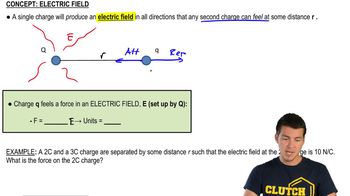
Electric Field

The electric field is a vector field around a charged object where a force would be exerted on other charges. It is defined as the force per unit charge and is measured in newtons per coulomb (N/C). The direction of the electric field is the direction of the force it would exert on a positive test charge.
Recommended video:
Guided course
03:16
Intro to Electric Fields

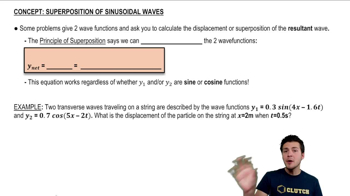
Superposition Principle

The superposition principle states that the net electric field created by multiple charges is the vector sum of the individual fields produced by each charge. This principle allows us to calculate the total electric field at a point by adding the fields due to each charge, considering both magnitude and direction.
Recommended video:
Guided course
03:32
Superposition of Sinusoidal Wave Functions

Coulomb's Law

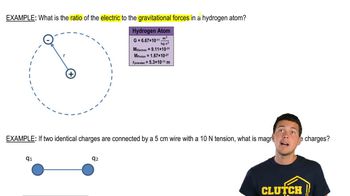
Coulomb's Law describes the force between two point charges. It states that the magnitude of the force is directly proportional to the product of the charges and inversely proportional to the square of the distance between them. The force is attractive if the charges are opposite and repulsive if they are the same.
Recommended video:
Guided course
09:52
Coulomb's Law
Related Practice
Textbook Question

A point charge q1=4.00q_1=-4.00 nC is at the point x=0.600x = 0.600 m, y=0.800y = 0.800 m, and a second point charge q2=+6.00q_2=+6.00 nC is at the point x=0.600x = 0.600 m, y=0y = 0. Calculate the magnitude and direction of the net electric field at the origin due to these two point charges.

Textbook Question

A point charge is placed at each corner of a square with side length aa. All charges have magnitude qq. Two of the charges are positive and two are negative (Fig. E21.4221.42). What is the direction of the net electric field at the center of the square due to the four charges, and what is its magnitude in terms of qq and aa?

Textbook Question

A +8.75+8.75-mC point charge is glued down on a horizontal frictionless table. It is tied to a 6.50-6.50-mC point charge by a light, nonconducting 2.502.50-cm wire. A uniform electric field of magnitude 1.85×1081.85\(\times\)10^8 N/CN/C is directed parallel to the wire, as shown in Fig. E21.3421.34. What would the tension be if both charges were negative?

1
views
Textbook Question

A proton is traveling horizontally to the right at 4.50×1064.50\(\times\)10^6 m/s. What minimum field (magnitude and direction) would be needed to stop an electron under the conditions of part (a)? Note: Part (a) asks for how much time does it take the proton to stop after entering the field.

1
views
Textbook Question

A +8.75+8.75-mC point charge is glued down on a horizontal frictionless table. It is tied to a 6.50-6.50-mC point charge by a light, nonconducting 2.502.50-cm wire. A uniform electric field of magnitude 1.85×1081.85\(\times\)10^8 N/CN/C is directed parallel to the wire, as shown in Fig. E21.3421.34. Find the tension in the wire.

1
views
Textbook Question

A 4.00-4.00-nC point charge is at the origin, and a second 5.00-5.00-nC point charge is on the xx-axis at x=0.800x = 0.800 m. Find the net electric force that the two charges would exert on an electron placed at each point in part (a). Note: Part (a) asked to find the electric field (magnitude and direction) at each of the following points on the xx-axis: (i) x=0.200x = 0.200 m; (ii) x=1.20x = 1.20 m; (iii) x=0.200x = -0.200 m.

1
views