Ch 20: The Second Law of Thermodynamics
Young & Freedman Calc - University Physics 15th Edition
Young & Freedman Calc15th EditionUniversity PhysicsISBN: 9780135159552Not the one you use?Change textbook
Chapter 20, Problem 22a

You decide to take a nice hot bath but discover that your thoughtless roommate has used up most of the hot water. You fill the tub with 195195 kg of 30.030.0°C water and attempt to warm it further by pouring in 5.005.00 kg of boiling water from the stove. Is this a reversible or an irreversible process? Use physical reasoning to explain.

Verified step by step guidance
1
Step 1: Understand the concept of reversible and irreversible processes. A reversible process is one where the system and surroundings can be returned to their original states without any changes. An irreversible process involves changes that cannot be undone without leaving a trace on the surroundings.
Step 2: Consider the mixing of hot and cold water. When you mix boiling water with cooler water, the temperature of the system changes, and heat is transferred from the hot water to the cooler water.
Step 3: Evaluate the entropy change. In a reversible process, the total entropy change of the system and surroundings is zero. In an irreversible process, the entropy of the system and surroundings increases.
Step 4: Analyze the energy exchange. The mixing of water at different temperatures results in an increase in entropy, as the energy disperses and the system moves towards thermal equilibrium.
Step 5: Conclude based on physical reasoning. Since the mixing of hot and cold water results in an increase in entropy and cannot be undone without external intervention, this process is irreversible.

Verified video answer for a similar problem:

This video solution was recommended by our tutors as helpful for the problem above.
Video duration:
1m
Was this helpful?

Key Concepts

Here are the essential concepts you must grasp in order to answer the question correctly.

Reversible and Irreversible Processes

In thermodynamics, a reversible process is an idealized process that happens infinitely slowly, allowing the system to remain in equilibrium at all times. In contrast, an irreversible process occurs spontaneously and involves dissipative factors like friction or turbulence, leading to a net increase in entropy. Mixing hot and cold water is typically irreversible due to the spontaneous nature of heat transfer and entropy increase.
Recommended video:
Guided course
08:45
Properties of Cyclic Thermodynamic Processes

Heat Transfer

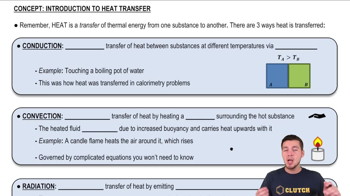
Heat transfer is the movement of thermal energy from a hotter object to a cooler one. It occurs through conduction, convection, or radiation. In this scenario, heat transfer occurs when boiling water is mixed with cooler bath water, resulting in a temperature change until thermal equilibrium is reached. This process is crucial for understanding how the temperature of the bath water changes.
Recommended video:
Guided course
05:14
Overview of Heat Transfer

Entropy

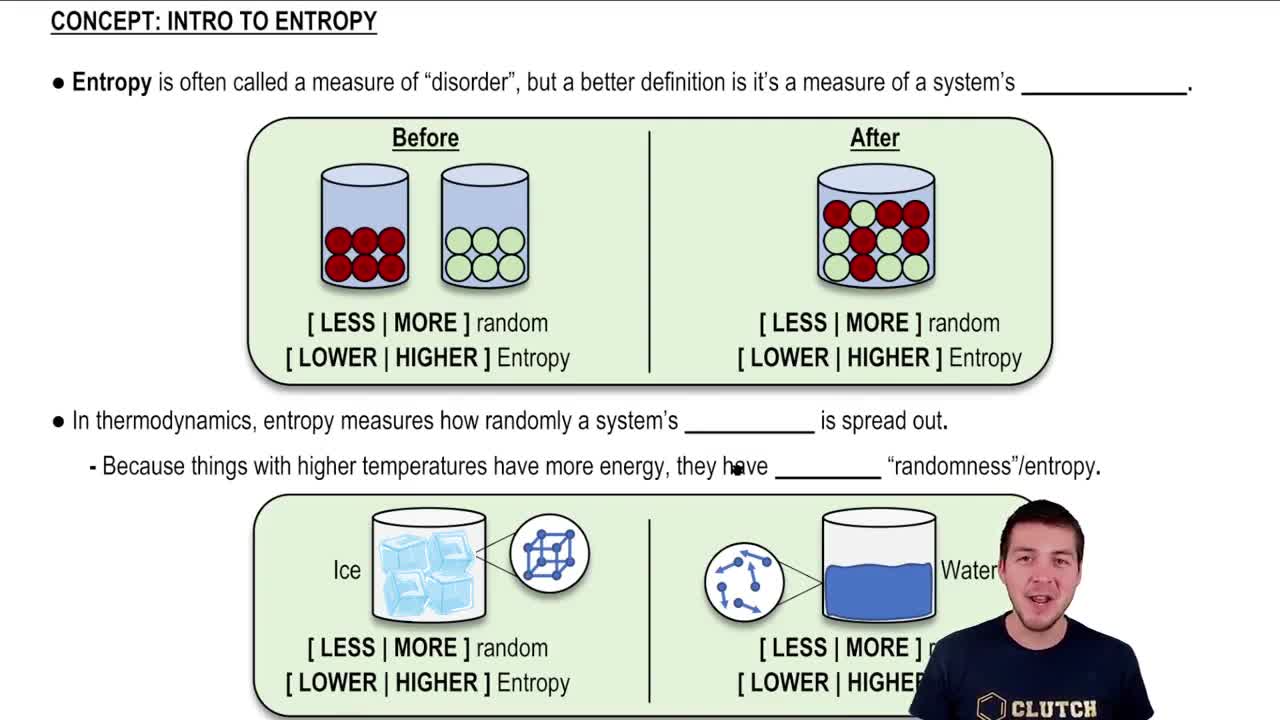
Entropy is a measure of the disorder or randomness in a system. In thermodynamics, it quantifies the amount of energy in a system that is unavailable for doing work. When two bodies at different temperatures mix, the entropy of the system increases, indicating an irreversible process. This concept helps explain why mixing hot and cold water leads to an increase in entropy, making the process irreversible.
Recommended video:
Guided course
07:50
Intro to Entropy