
Ch 20: The Second Law of Thermodynamics
Young & Freedman Calc - University Physics 15th Edition
Young & Freedman Calc15th EditionUniversity PhysicsISBN: 9780135159552Not the one you use?Change textbook
Chapter 20, Problem 20

A Carnot heat engine uses a hot reservoir consisting of a large amount of boiling water and a cold reservoir consisting of a large tub of ice and water. In 55 minutes of operation, the heat rejected by the engine melts 0.04000.0400 kg of ice. During this time, how much work WW is performed by the engine?

Verified step by step guidance
1
Understand the concept of a Carnot heat engine: It operates between two thermal reservoirs, absorbing heat from the hot reservoir and rejecting some of it to the cold reservoir, while performing work.
Identify the key information: The heat rejected by the engine melts 0.0400 kg of ice. The latent heat of fusion for ice is approximately 334,000 J/kg.
Calculate the heat rejected to the cold reservoir: Use the formula for the heat required to melt ice, \( Q_c = m \cdot L_f \), where \( m \) is the mass of ice and \( L_f \) is the latent heat of fusion.
Apply the Carnot efficiency formula: \( \eta = 1 - \frac{T_c}{T_h} \), where \( T_c \) and \( T_h \) are the temperatures of the cold and hot reservoirs, respectively. This will help determine the relationship between the heat absorbed \( Q_h \), the heat rejected \( Q_c \), and the work done \( W \).
Use the relationship \( W = Q_h - Q_c \) to find the work done by the engine, knowing \( Q_c \) and using the efficiency to find \( Q_h \).

Verified video answer for a similar problem:

This video solution was recommended by our tutors as helpful for the problem above.
Video duration:
5m
Was this helpful?

Key Concepts

Here are the essential concepts you must grasp in order to answer the question correctly.

Carnot Heat Engine

A Carnot heat engine is an idealized engine that operates between two thermal reservoirs, converting heat into work with maximum efficiency. It follows the Carnot cycle, which consists of two isothermal processes and two adiabatic processes. The efficiency of a Carnot engine depends solely on the temperatures of the hot and cold reservoirs.
Recommended video:
Guided course
06:25
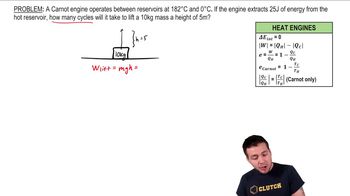
Lifting Mass with a Heat Engine

Latent Heat of Fusion

The latent heat of fusion is the amount of energy required to change a substance from solid to liquid at its melting point without changing its temperature. For ice, this value is approximately 334,000 J/kg. In the context of the problem, this concept helps determine the heat rejected by the engine, as it is used to melt the ice.
Recommended video:
Guided course
10:40
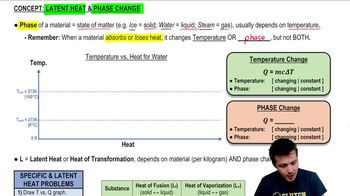
Latent Heat & Phase Changes

First Law of Thermodynamics

The first law of thermodynamics, also known as the law of energy conservation, states that energy cannot be created or destroyed, only transformed. In the context of a heat engine, it implies that the work done by the engine is equal to the heat absorbed from the hot reservoir minus the heat rejected to the cold reservoir. This principle is crucial for calculating the work performed by the engine.
Recommended video:
Guided course
08:04
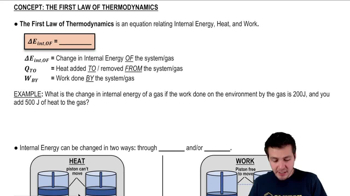
The First Law of Thermodynamics