
Ch 19: The First Law of Thermodynamics
Young & Freedman Calc - University Physics 15th Edition
Young & Freedman Calc15th EditionUniversity PhysicsISBN: 9780135159552Not the one you use?Change textbook
Chapter 19, Problem 4b

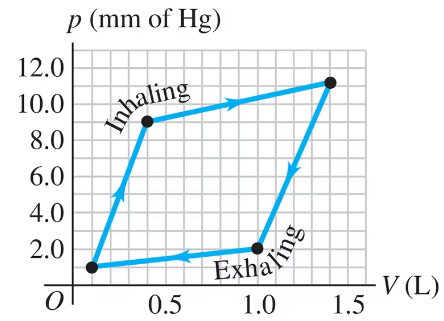
The graph in Fig. E19.419.4 shows a pVpV-diagram of the air in a human lung when a person is inhaling and then exhaling a deep breath. Such graphs, obtained in clinical practice, are normally somewhat curved, but we have modeled one as a set of straight lines of the same general shape. (Important: The pressure shown is the gauge pressure, not the absolute pressure.) The process illustrated here is somewhat different from those we have been studying, because the pressure change is due to changes in the amount of gas in the lung, not to temperature changes. (Think of your own breathing. Your lungs do not expand because they've gotten hot.) If the temperature of the air in the lung remains a reasonable 20 20°C, what is the maximum number of moles in this person's lung during a breath?
Graph of lung pV diagram with straight lines showing inhaling and exhaling phases, pressure in mm Hg, volume in liters.

Verified step by step guidance
1
Identify the relevant equation for the problem. Since we are dealing with a pV-diagram and need to find the number of moles, we can use the ideal gas law: \( PV = nRT \), where \( P \) is pressure, \( V \) is volume, \( n \) is the number of moles, \( R \) is the ideal gas constant, and \( T \) is the temperature in Kelvin.
Convert the given temperature from Celsius to Kelvin. The temperature in Kelvin is given by \( T(K) = T(°C) + 273.15 \). For this problem, \( T = 20°C \), so \( T = 20 + 273.15 \).
Determine the maximum pressure and volume from the pV-diagram. These values will be used to calculate the maximum number of moles. Ensure that the pressure is converted to absolute pressure by adding atmospheric pressure if necessary, since the graph shows gauge pressure.
Substitute the maximum pressure, volume, and temperature into the ideal gas law equation to solve for the maximum number of moles \( n \). Rearrange the equation to solve for \( n \): \( n = \frac{PV}{RT} \).
Use the ideal gas constant \( R = 8.314 \text{ J/(mol·K)} \) and substitute all known values into the equation to calculate \( n \). This will give you the maximum number of moles in the person's lung during a breath.

Verified video answer for a similar problem:

This video solution was recommended by our tutors as helpful for the problem above.
Video duration:
13m
Was this helpful?

Key Concepts

Here are the essential concepts you must grasp in order to answer the question correctly.

Ideal Gas Law

The Ideal Gas Law is a fundamental equation in physics that relates the pressure, volume, and temperature of an ideal gas with the number of moles. It is expressed as PV = nRT, where P is pressure, V is volume, n is the number of moles, R is the ideal gas constant, and T is temperature. This law is crucial for calculating the number of moles in the lungs when pressure and volume are known, assuming constant temperature.
Recommended video:
Guided course
07:21
Ideal Gases and the Ideal Gas Law

Gauge Pressure

Gauge pressure is the pressure of a system above atmospheric pressure. It is important to distinguish it from absolute pressure, which includes atmospheric pressure. In the context of the lungs, the gauge pressure is used to measure the pressure changes due to inhalation and exhalation, which is essential for applying the Ideal Gas Law to determine the number of moles of air in the lungs.
Recommended video:
Guided course
09:27
Pressure Gauges: Barometer

Isothermal Process

An isothermal process is a thermodynamic process in which the temperature remains constant. In the context of the lungs, the problem assumes that the temperature of the air remains at 20°C during breathing. This assumption allows us to use the Ideal Gas Law without accounting for temperature changes, simplifying the calculation of the number of moles of air in the lungs.
Recommended video:
Guided course
06:13
Entropy & Ideal Gas Processes
Related Practice
Textbook Question

A gas undergoes two processes. In the first, the volume remains constant at 0.2000.200 m3 and the pressure increases from 2.00×1052.00\(\times\)10^5 Pa to 5.00×1055.00\(\times\)10^5 Pa. The second process is a compression to a volume of 0.1200.120 m3 at a constant pressure of 5.00×1055.00\(\times\)10^5 Pa. Find the total work done by the gas during both processes.

1
views
Textbook Question

Two moles of an ideal gas are heated at constant pressure from T=27T = 27°C to T=107T = 107°C. Calculate the work done by the gas.

1
views
Textbook Question

In Fig. 19.719.7a, consider the closed loop 132411 → 3 → 2 → 4 → 1. This is a cyclic process in which the initial and final states are the same. Find the total work done by the system in this cyclic process, and show that it is equal to the area enclosed by the loop.

2
views
Textbook Question

A gas undergoes two processes. In the first, the volume remains constant at 0.2000.200 m3 and the pressure increases from 2.00×1052.00\(\times\)10^5 Pa to 5.00×1055.00\(\times\)10^5 Pa. The second process is a compression to a volume of 0.1200.120 m3 at a constant pressure of 5.00×1055.00\(\times\)10^5 Pa. In a pVpV-diagram, show both processes.

2
views
Textbook Question

The graph in Fig. E19.419.4 shows a pVpV-diagram of the air in a human lung when a person is inhaling and then exhaling a deep breath. Such graphs, obtained in clinical practice, are normally somewhat curved, but we have modeled one as a set of straight lines of the same general shape. (Important: The pressure shown is the gauge pressure, not the absolute pressure.) How many joules of net work does this person's lung do during one complete breath?

Textbook Question

Six moles of an ideal gas are in a cylinder fitted at one end with a movable piston. The initial temperature of the gas is 27.027.0°C and the pressure is constant. As part of a machine design project, calculate the final temperature of the gas after it has done 2.40×1032.40\(\times\)10^3 J of work.