
Ch 17: Temperature and Heat
Young & Freedman Calc - University Physics 15th Edition
Young & Freedman Calc15th EditionUniversity PhysicsISBN: 9780135159552Not the one you use?Change textbook
Chapter 17, Problem 7

The pressure of a gas at the triple point of water is 1.351.35 atm. If its volume remains unchanged, what will its pressure be at the temperature at which CO2 solidifies?

Verified step by step guidance
1
Identify the initial conditions: The pressure of the gas is 1.35 atm, and the volume remains unchanged. This suggests that we are dealing with a scenario where the volume is constant, which is a key aspect of the problem.
Recognize the relationship between pressure and temperature for a gas at constant volume. According to Gay-Lussac's Law, the pressure of a gas is directly proportional to its temperature when the volume is held constant. This can be expressed as: PT = PT, where P is pressure and T is temperature.
Determine the temperature at which CO2 solidifies. Carbon dioxide solidifies at a temperature of approximately -78.5°C, which is equivalent to 194.65 K. This is the temperature at which you need to calculate the new pressure.
Use the proportional relationship from Gay-Lussac's Law to set up the equation: P1T1 = P2T2. Here, P1 is the initial pressure (1.35 atm), T1 is the initial temperature (273.15 K, the triple point of water), P2 is the final pressure, and T2 is the final temperature (194.65 K).
Solve for the final pressure P2 using the equation: P2 = P1 * T2T1. Substitute the known values to find the pressure at the temperature at which CO2 solidifies.

Verified video answer for a similar problem:

This video solution was recommended by our tutors as helpful for the problem above.
Video duration:
3m
Was this helpful?

Key Concepts

Here are the essential concepts you must grasp in order to answer the question correctly.

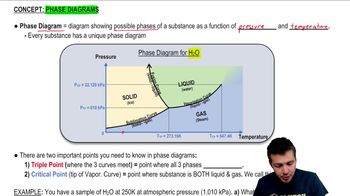
Triple Point

The triple point of a substance is the unique temperature and pressure at which the three phases (gas, liquid, and solid) coexist in equilibrium. For water, this occurs at 0.01°C and 611.657 pascals. Understanding the triple point is crucial for determining phase changes and conditions under which substances transition between states.
Recommended video:
Guided course
06:59
Phase Diagrams

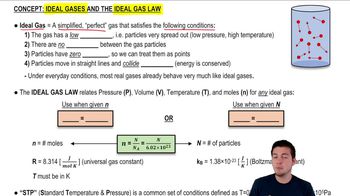
Ideal Gas Law

The Ideal Gas Law, expressed as PV=nRT, relates the pressure (P), volume (V), and temperature (T) of a gas with its amount in moles (n) and the ideal gas constant (R). It is essential for predicting how changes in temperature affect pressure when volume is constant, assuming the gas behaves ideally.
Recommended video:
Guided course
07:21
Ideal Gases and the Ideal Gas Law

Phase Transition of CO2

CO2 solidifies at a specific temperature and pressure, known as its sublimation point, which is -78.5°C at 1 atm. Understanding this phase transition is crucial for determining the conditions under which CO2 changes from gas to solid, affecting its pressure if the volume remains constant.
Recommended video:
Guided course
08:59
Phase Constant of a Wave Function