Ch 17: Temperature and Heat
Young & Freedman Calc - University Physics 15th Edition
Young & Freedman Calc15th EditionUniversity PhysicsISBN: 9780135159552Not the one you use?Change textbook
Chapter 17, Problem 17.41

A 6.00-kg piece of solid copper metal at an initial temperature T is placed with 2.00 kg of ice that is initially at -20.0°C. The ice is in an insulated container of negligible mass and no heat is exchanged with the surroundings. After thermal equilibrium is reached, there is 1.20 kg of ice and 0.80 kg of liquid water. What was the initial temperature of the piece of copper?

Verified step by step guidance
1
Identify the heat transfer processes involved: The copper will lose heat, and the ice will gain heat. The heat gained by the ice will first raise its temperature to 0°C, then melt some of it into water, and finally raise the temperature of the resulting water to the equilibrium temperature.
Use the specific heat capacity formula to calculate the heat lost by the copper: \( Q_{\text{copper}} = m_{\text{copper}} \cdot c_{\text{copper}} \cdot (T_{\text{final}} - T_{\text{initial}}) \), where \( m_{\text{copper}} = 6.00 \text{ kg} \), \( c_{\text{copper}} = 385 \text{ J/kg°C} \), and \( T_{\text{final}} \) is the equilibrium temperature.
Calculate the heat required to raise the temperature of the ice from -20.0°C to 0°C using \( Q_{\text{ice warming}} = m_{\text{ice}} \cdot c_{\text{ice}} \cdot (0 - (-20.0)) \), where \( m_{\text{ice}} = 2.00 \text{ kg} \) and \( c_{\text{ice}} = 2.09 \text{ J/g°C} \).
Calculate the heat required to melt 0.80 kg of ice into water using \( Q_{\text{melting}} = m_{\text{melted ice}} \cdot L_f \), where \( m_{\text{melted ice}} = 0.80 \text{ kg} \) and \( L_f = 334 \text{ kJ/kg} \).
Set up the energy balance equation: The total heat lost by the copper equals the total heat gained by the ice and water. Solve for the initial temperature of the copper using the equation: \( Q_{\text{copper}} = Q_{\text{ice warming}} + Q_{\text{melting}} + Q_{\text{water warming}} \), where \( Q_{\text{water warming}} = m_{\text{water}} \cdot c_{\text{water}} \cdot (T_{\text{final}} - 0) \) and \( c_{\text{water}} = 4.18 \text{ J/g°C} \).

Verified video answer for a similar problem:

This video solution was recommended by our tutors as helpful for the problem above.
Video duration:
9m
Was this helpful?

Key Concepts

Here are the essential concepts you must grasp in order to answer the question correctly.

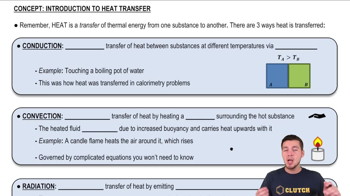
Heat Transfer

Heat transfer is the process of thermal energy moving from a hotter object to a cooler one until thermal equilibrium is reached. In this scenario, the copper transfers heat to the ice, causing some of it to melt. Understanding the principles of heat transfer, including conduction and the conservation of energy, is crucial for solving this problem.
Recommended video:
Guided course
05:14
Overview of Heat Transfer

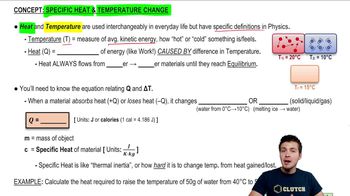
Specific Heat Capacity

Specific heat capacity is the amount of heat required to change the temperature of a unit mass of a substance by one degree Celsius. For copper, this value is needed to calculate how much heat the copper can release as it cools. This concept helps determine the initial temperature of the copper by equating the heat lost by copper to the heat gained by the ice.
Recommended video:
Guided course
06:50
Specific Heat & Temperature Changes

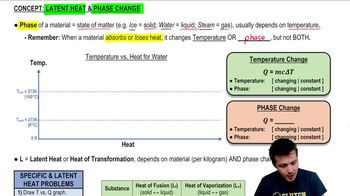
Phase Change and Latent Heat

Phase change involves the transformation of a substance from one state of matter to another, such as ice melting into water. Latent heat is the heat absorbed or released during a phase change without a change in temperature. In this problem, the latent heat of fusion for ice is essential to calculate the energy required to melt the ice, which helps in determining the initial temperature of the copper.
Recommended video:
Guided course
10:40
Latent Heat & Phase Changes