Ch 13: Gravitation
Young & Freedman Calc - University Physics 15th Edition
Young & Freedman Calc15th EditionUniversity PhysicsISBN: 9780135159552Not the one you use?Change textbook
Chapter 13, Problem 5

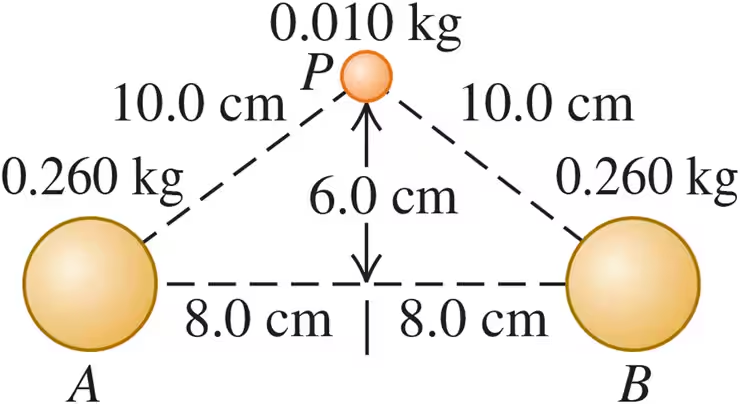
Two uniform spheres, each of mass 0.260 kg, are fixed at points A and B (Fig. E13.5). Find the magnitude and direction of the initial acceleration of a uniform sphere with mass 0.010 kg if released from rest at point P and acted on only by forces of gravitational attraction of the spheres at A and B.

Verified step by step guidance
1
Identify the forces acting on the sphere at point P due to the gravitational attraction from the spheres at points A and B. Use Newton's law of universal gravitation: F=GmMr2, where G is the gravitational constant, m and M are the masses of the spheres, and r is the distance between the spheres.
Calculate the gravitational force exerted by the sphere at point A on the sphere at point P. Use the formula: F=GmMr2, substituting the appropriate values for the masses and distance.
Calculate the gravitational force exerted by the sphere at point B on the sphere at point P using the same formula as in step 2, substituting the appropriate values for the masses and distance.
Determine the net gravitational force acting on the sphere at point P by vectorially adding the forces calculated in steps 2 and 3. Consider the direction of each force based on the positions of points A and B relative to point P.
Use Newton's second law of motion, F=ma, to find the magnitude and direction of the initial acceleration of the sphere at point P. Solve for a by dividing the net force by the mass of the sphere at point P.

Verified video answer for a similar problem:

This video solution was recommended by our tutors as helpful for the problem above.
Video duration:
13m
Was this helpful?

Key Concepts

Here are the essential concepts you must grasp in order to answer the question correctly.

Newton's Law of Universal Gravitation

Newton's Law of Universal Gravitation states that every point mass attracts every other point mass by a force acting along the line intersecting both points. The magnitude of the force is proportional to the product of the masses and inversely proportional to the square of the distance between them. This law is essential for calculating the gravitational forces exerted by the spheres at points A and B on the sphere at point P.
Recommended video:
Guided course
04:05
Universal Law of Gravitation

Superposition Principle

The Superposition Principle in physics states that the net force acting on an object is the vector sum of all individual forces acting on it. In this problem, the sphere at point P experiences gravitational forces from both spheres at points A and B, and the superposition principle allows us to calculate the resultant force by summing these individual forces vectorially.
Recommended video:
Guided course
03:32
Superposition of Sinusoidal Wave Functions

Newton's Second Law of Motion

Newton's Second Law of Motion states that the acceleration of an object is directly proportional to the net force acting on it and inversely proportional to its mass. This law is crucial for determining the initial acceleration of the sphere at point P once the net gravitational force is calculated, as it relates the force to the sphere's acceleration.
Recommended video:
Guided course
06:54
Intro to Forces & Newton's Second Law