Ch 13: Gravitation
Young & Freedman Calc - University Physics 15th Edition
Young & Freedman Calc15th EditionUniversity PhysicsISBN: 9780135159552Not the one you use?Change textbook
Chapter 13, Problem 7

A typical adult human has a mass of about 70 kg. (a) What force does a full moon exert on such a human when it is directly overhead with its center 378,000 km away? (b) Compare this force with the force exerted on the human by the earth

Verified step by step guidance
1
Step 1: Begin by understanding the concept of gravitational force, which is given by Newton's law of universal gravitation. The formula is: F=GmMr2, where F is the gravitational force, G is the gravitational constant, m and M are the masses of the two objects, and r is the distance between the centers of the two objects.
Step 2: Calculate the gravitational force exerted by the moon on the human. Use the mass of the moon, which is approximately 7.35×10²² kg, the mass of the human 70 kg, and the distance 378000 km (convert this to meters). Plug these values into the gravitational force formula.
Step 3: Calculate the gravitational force exerted by the Earth on the human. Use the mass of the Earth, which is approximately 5.97×1024 kg, the mass of the human 70 kg, and the average radius of the Earth 6371 km (convert this to meters). Use the gravitational force formula again.
Step 4: Compare the two forces calculated in steps 2 and 3. This will involve dividing the force exerted by the moon by the force exerted by the Earth to find the ratio of the two forces.
Step 5: Reflect on the results. Consider why the force exerted by the moon is much smaller than the force exerted by the Earth, despite the moon's significant mass. This is due to the much larger distance between the moon and the human compared to the distance between the Earth and the human.

Verified video answer for a similar problem:

This video solution was recommended by our tutors as helpful for the problem above.
Video duration:
4m
Was this helpful?

Key Concepts

Here are the essential concepts you must grasp in order to answer the question correctly.

Gravitational Force

Gravitational force is the attractive force between two masses. It is calculated using Newton's law of universal gravitation, which states that the force is proportional to the product of the masses and inversely proportional to the square of the distance between their centers. This concept is essential for determining the force exerted by the moon on a human.
Recommended video:
Guided course
05:41
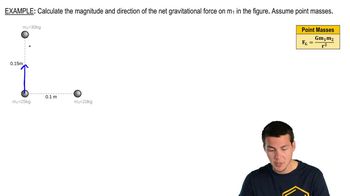
Gravitational Forces in 2D

Mass and Distance

Mass and distance are critical factors in calculating gravitational force. The mass of the objects involved, such as the moon and the human, directly affects the magnitude of the force. The distance between the objects' centers, in this case, 378,000 km, is crucial as the force decreases with the square of the distance, highlighting the importance of these parameters in gravitational calculations.
Recommended video:
Guided course
07:45
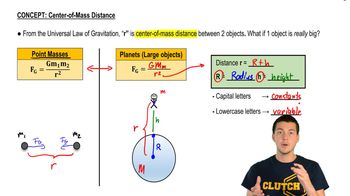
Center of Mass Distance

Comparison of Forces

Comparing forces involves analyzing the relative magnitudes of different forces acting on an object. In this scenario, it requires calculating the gravitational force exerted by both the moon and the Earth on the human and comparing them. This concept helps understand the dominance of Earth's gravitational pull due to its larger mass and closer proximity compared to the moon.
Recommended video:
Guided course
06:48
Intro to Centripetal Forces