
Ch 12: Fluid Mechanics
Young & Freedman Calc - University Physics 15th Edition
Young & Freedman Calc15th EditionUniversity PhysicsISBN: 9780135159552Not the one you use?Change textbook
Chapter 12, Problem 7

Oceans on Mars. Scientists have found evidence that Mars may once have had an ocean 0.500 km deep. The acceleration due to gravity on Mars is 3.71 m/s2. (a) What would be the gauge pressure at the bottom of such an ocean, assuming it was freshwater? (b) To what depth would you need to go in the earth's ocean to experience the same gauge pressure?

Verified step by step guidance
1
Step 1: Understand the concept of gauge pressure. Gauge pressure is the pressure relative to atmospheric pressure. It can be calculated using the formula: \( P = \rho \cdot g \cdot h \), where \( P \) is the gauge pressure, \( \rho \) is the density of the fluid, \( g \) is the acceleration due to gravity, and \( h \) is the depth of the fluid.
Step 2: Calculate the gauge pressure at the bottom of the Martian ocean. Assume the density of freshwater is \( 1000 \text{ kg/m}^3 \). Use the given depth \( h = 0.500 \text{ km} = 500 \text{ m} \) and the acceleration due to gravity on Mars \( g = 3.71 \text{ m/s}^2 \). Substitute these values into the formula: \( P = 1000 \cdot 3.71 \cdot 500 \).
Step 3: Calculate the gauge pressure at a certain depth in Earth's ocean. Use the same formula \( P = \rho \cdot g \cdot h \), but this time with Earth's gravity \( g = 9.81 \text{ m/s}^2 \). Set the gauge pressure \( P \) equal to the pressure calculated for Mars and solve for \( h \).
Step 4: Rearrange the formula to solve for the depth \( h \) in Earth's ocean: \( h = \frac{P}{\rho \cdot g} \). Substitute the gauge pressure from Mars and Earth's gravity into the equation: \( h = \frac{1000 \cdot 3.71 \cdot 500}{1000 \cdot 9.81} \).
Step 5: Simplify the expression to find the depth \( h \) in Earth's ocean that would result in the same gauge pressure as at the bottom of the Martian ocean.

Verified video answer for a similar problem:

This video solution was recommended by our tutors as helpful for the problem above.
Video duration:
4m
Was this helpful?

Key Concepts

Here are the essential concepts you must grasp in order to answer the question correctly.

Gauge Pressure

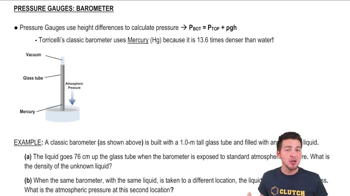
Gauge pressure is the pressure relative to atmospheric pressure. It is calculated by subtracting atmospheric pressure from the absolute pressure. In the context of fluids, gauge pressure at a certain depth is determined by the weight of the fluid above that point, which is influenced by the fluid's density and the gravitational force.
Recommended video:
Guided course
09:27
Pressure Gauges: Barometer

Hydrostatic Pressure Formula

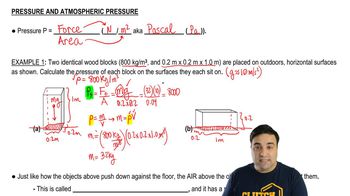
Hydrostatic pressure in a fluid at rest is given by the formula P = ρgh, where P is the pressure, ρ is the fluid density, g is the acceleration due to gravity, and h is the depth of the fluid. This formula helps calculate the pressure exerted by a fluid column, which is crucial for determining gauge pressure at a specific depth.
Recommended video:
Guided course
17:04
Pressure and Atmospheric Pressure

Comparative Gravitational Forces

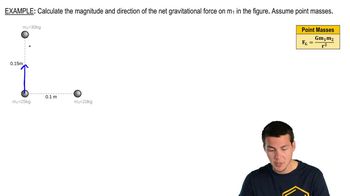
Gravitational force varies between planets, affecting fluid pressure calculations. Mars has a gravitational acceleration of 3.71 m/s², while Earth's is approximately 9.81 m/s². Understanding these differences is essential for comparing pressures in oceans on Mars and Earth, as the same depth will yield different pressures due to varying gravitational forces.
Recommended video:
Guided course
05:41
Gravitational Forces in 2D