
Oceans on Mars. Scientists have found evidence that Mars may once have had an ocean 0.500 km deep. The acceleration due to gravity on Mars is 3.71 m/s2. (a) What would be the gauge pressure at the bottom of such an ocean, assuming it was freshwater? (b) To what depth would you need to go in the earth's ocean to experience the same gauge pressure?
A cube 5.0 cm on each side is made of a metal alloy. After you drill a cylindrical hole 2.0 cm in diameter all the way through and perpendicular to one face, you find that the cube weighs 6.30 N. What is the density of this metal?
Verified step by step guidance
Verified video answer for a similar problem:
Key Concepts
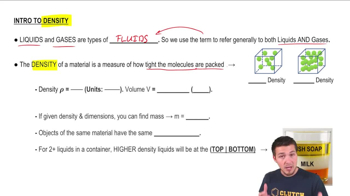
Density
Volume of a Cube and Cylinder
Buoyancy and Weight
In intravenous feeding, a needle is inserted in a vein in the patient's arm and a tube leads from the needle to a reservoir of fluid (density 1050 kg/m3) located at height h above the arm. The top of the reservoir is open to the air. If the gauge pressure inside the vein is 5980 Pa, what is the minimum value of h that allows fluid to enter the vein? Assume the needle diameter is large enough that you can ignore the viscosity of the liquid.
On a part-time job, you are asked to bring a cylindrical iron rod of length 85.8 cm and diameter 2.85 cm from a storage room to a machinist. Will you need a cart? (To answer, calculate the weight of the rod.)
A barrel contains a 0.120-m layer of oil floating on water that is 0.250 m deep. The density of the oil is 600 kg/m3. (a) What is the gauge pressure at the oil–water interface? (b) What is the gauge pressure at the bottom of the barrel?
