Ch 10: Dynamics of Rotational Motion
Young & Freedman Calc - University Physics 15th Edition
Young & Freedman Calc15th EditionUniversity PhysicsISBN: 9780135159552Not the one you use?Change textbook
Chapter 10, Problem 41a

A hollow, thin-walled sphere of mass 12.0kg12.0\(\operatorname{kg}\) and diameter 48.0 cm48.0\(\text{ cm}\) is rotating about an axle through its center. The angle (in radians) through which it turns as a function of time (in seconds) is given by θ(t)=At2+Bt4θ(t) = At^2 + Bt^4, where A has numerical value 1.501.50 and B has numerical value 1.101.10. What are the units of the constants A and B?

Verified step by step guidance
1
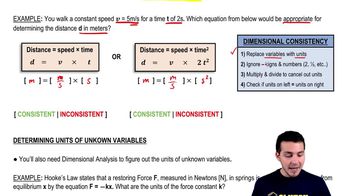
To determine the units of the constants A and B, we need to analyze the equation θ(t) = At^2 + Bt^4. The angle θ is measured in radians, which are dimensionless. Therefore, the units of At^2 and Bt^4 must also be dimensionless.
Consider the term At^2. Since t is time measured in seconds (s), t^2 has units of s^2. For At^2 to be dimensionless, the units of A must be the inverse of s^2, which is s^-2.
Now, consider the term Bt^4. Similarly, t^4 has units of s^4. For Bt^4 to be dimensionless, the units of B must be the inverse of s^4, which is s^-4.
Thus, the units of A are s^-2, and the units of B are s^-4.
This analysis ensures that each term in the equation θ(t) = At^2 + Bt^4 is dimensionally consistent, resulting in a dimensionless angle θ.

Verified video answer for a similar problem:

This video solution was recommended by our tutors as helpful for the problem above.
Video duration:
3m
Was this helpful?

Key Concepts

Here are the essential concepts you must grasp in order to answer the question correctly.

Angular Displacement

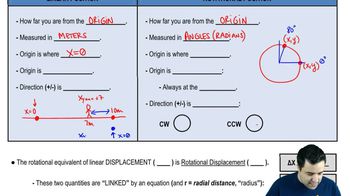
Angular displacement is the angle through which a point or line has been rotated in a specified sense about a specified axis. It is measured in radians, which is a dimensionless unit. In the given function θ(t) = At^2 + Bt^4, θ represents the angular displacement as a function of time.
Recommended video:
Guided course
14:03
Rotational Position & Displacement

Dimensional Analysis

Dimensional analysis involves checking the consistency of units in equations. It helps determine the units of constants by ensuring that both sides of an equation have the same dimensions. For θ(t) = At^2 + Bt^4, the units of A and B can be found by ensuring the terms At^2 and Bt^4 have units of radians.
Recommended video:
Guided course
05:00
Dimensional Analysis

Rotational Motion

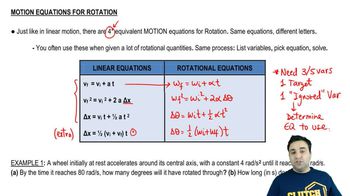
Rotational motion refers to the motion of a body around a center or axis. It involves concepts like angular velocity and angular acceleration. In this problem, understanding how angular displacement changes with time is crucial, as it relates to the rotational dynamics of the sphere described by θ(t) = At^2 + Bt^4.
Recommended video:
Guided course
07:18
Equations of Rotational Motion
Related Practice
Textbook Question

A 2.00-kg rock has a horizontal velocity of magnitude 12.0 m/s when it is at point P in Fig. E10.35. At this instant, what are the magnitude and direction of its angular momentum relative to point O?

2
views

Textbook Question

A small block on a frictionless, horizontal surface has a mass of 0.0250 kg. It is attached to a massless cord passing through a hole in the surface (Fig. E10.40). The block is originally revolving at a distance of 0.300 m from the hole with an angular speed of 2.85 rad/s. The cord is then pulled from below, shortening the radius of the circle in which the block revolves to 0.150 m. Model the block as a particle. Find the change in kinetic energy of the block.

3
views
Textbook Question

A 2.00-kg rock has a horizontal velocity of magnitude 12.0 m/s when it is at point P in Fig. E10.35. If the only force acting on the rock is its weight, what is the rate of change (magnitude and direction) of its angular momentum at this instant?

1
views
Textbook Question

A woman with mass 50 kg is standing on the rim of a large disk that is rotating at 0.80 rev/s about an axis through its center. The disk has mass 110 kg and radius 4.0 m. Calculate the magnitude of the total angular momentum of the woman–disk system. (Assume that you can treat the woman as a point.)

1
views
Textbook Question

A small block on a frictionless, horizontal surface has a mass of 0.0250 kg. It is attached to a massless cord passing through a hole in the surface (Fig. E10.40). The block is originally revolving at a distance of 0.300 m from the hole with an angular speed of 2.85 rad/s. The cord is then pulled from below, shortening the radius of the circle in which the block revolves to 0.150 m. Model the block as a particle. What is the new angular speed?

2
views
Textbook Question

A small block on a frictionless, horizontal surface has a mass of 0.0250 kg. It is attached to a massless cord passing through a hole in the surface (Fig. E10.40). The block is originally revolving at a distance of 0.300 m from the hole with an angular speed of 2.85 rad/s. The cord is then pulled from below, shortening the radius of the circle in which the block revolves to 0.150 m. Model the block as a particle. Is the angular momentum of the block conserved? Why or why not?

1
views