
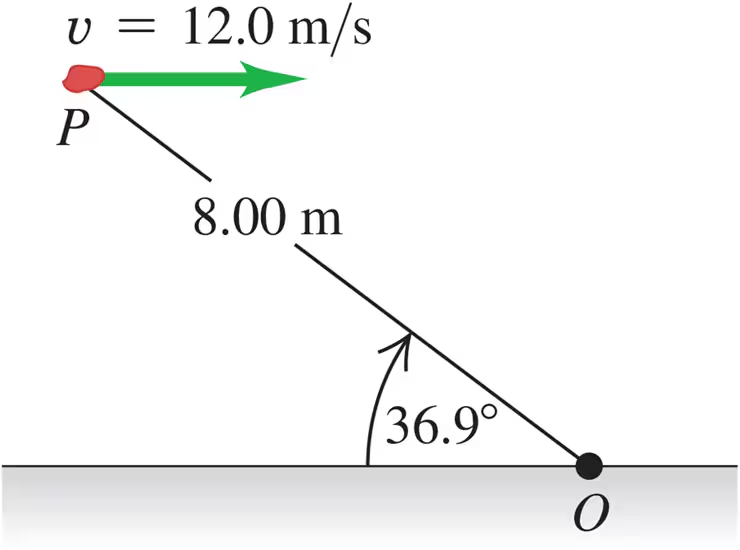
A 2.00-kg rock has a horizontal velocity of magnitude 12.0 m/s when it is at point P in Fig. E10.35. If the only force acting on the rock is its weight, what is the rate of change (magnitude and direction) of its angular momentum at this instant?
A 2.00-kg rock has a horizontal velocity of magnitude 12.0 m/s when it is at point P in Fig. E10.35. At this instant, what are the magnitude and direction of its angular momentum relative to point O?

Verified step by step guidance
Verified video answer for a similar problem:
Key Concepts
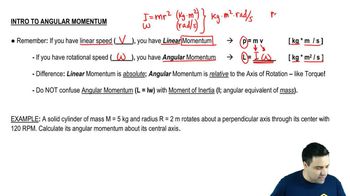
Angular Momentum
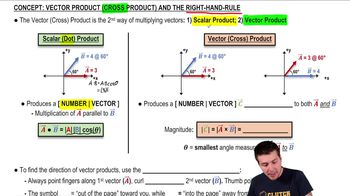
Cross Product
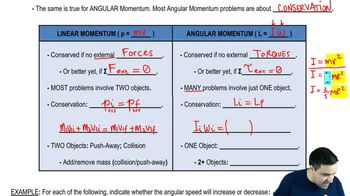
Conservation of Angular Momentum
A 2.80-kg grinding wheel is in the form of a solid cylinder of radius 0.100 m. What constant torque will bring it from rest to an angular speed of 1200 rev/min in 2.5 s?
A woman with mass 50 kg is standing on the rim of a large disk that is rotating at 0.80 rev/s about an axis through its center. The disk has mass 110 kg and radius 4.0 m. Calculate the magnitude of the total angular momentum of the woman–disk system. (Assume that you can treat the woman as a point.)
An airplane propeller is 2.08 m in length (from tip to tip) and has a mass of 117 kg. When the airplane's engine is first started, it applies a constant torque of 1950 Nm to the propeller, which starts from rest. What is the instantaneous power output of the motor at the instant that the propeller has turned through 5.00 revolutions?
An electric motor consumes 9.00 kJ of electrical energy in 1.00 min. If one-third of this energy goes into heat and other forms of internal energy of the motor, with the rest going to the motor output, how much torque will this engine develop if you run it at 2500 rpm?
A hollow, thin-walled sphere of mass and diameter is rotating about an axle through its center. The angle (in radians) through which it turns as a function of time (in seconds) is given by , where A has numerical value and B has numerical value . What are the units of the constants A and B?
