Ch 10: Dynamics of Rotational Motion
Young & Freedman Calc - University Physics 15th Edition
Young & Freedman Calc15th EditionUniversity PhysicsISBN: 9780135159552Not the one you use?Change textbook
Chapter 10, Problem 6a

A metal bar is in the xyxy-plane with one end of the bar at the origin. A force F=(7.00N)i+(3.00N)j\(\overrightarrow{F}\)=\(\left\)(7.00N\(\right\))i+(-3.00N)j is applied to the bar at the point x=3.00 mx=3.00\(\text{ m}\), y=4.00 my=4.00\(\text{ m}\). In terms of unit vectors ii and jj, what is the position vector rr for the point where the force is applied?

Verified step by step guidance
1
Identify the coordinates of the point where the force is applied. The point is given as (x = 3.00 m, y = 4.00 m).
Understand that the position vector \( \mathbf{r} \) is a vector that points from the origin to the point where the force is applied. It is expressed in terms of unit vectors \( \mathbf{i} \) and \( \mathbf{j} \).
Write the position vector \( \mathbf{r} \) using the coordinates of the point. The position vector \( \mathbf{r} \) can be expressed as \( \mathbf{r} = x \mathbf{i} + y \mathbf{j} \).
Substitute the given values of x and y into the position vector equation. This gives \( \mathbf{r} = 3.00 \mathbf{i} + 4.00 \mathbf{j} \).
Conclude that the position vector \( \mathbf{r} \) for the point where the force is applied is \( 3.00 \mathbf{i} + 4.00 \mathbf{j} \).

Verified video answer for a similar problem:

This video solution was recommended by our tutors as helpful for the problem above.
Video duration:
2m
Was this helpful?

Key Concepts

Here are the essential concepts you must grasp in order to answer the question correctly.

Position Vector

A position vector describes the location of a point in space relative to an origin. In the xy-plane, it is expressed using unit vectors i and j, representing the x and y components, respectively. For a point at coordinates (x, y), the position vector r is given by r = xi + yj, where x and y are the respective distances from the origin along the x and y axes.
Recommended video:
Guided course
07:07
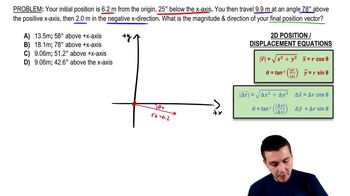
Final Position Vector

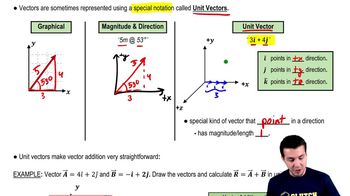
Unit Vectors

Unit vectors are vectors with a magnitude of one, used to indicate direction in a coordinate system. In the context of the xy-plane, i and j are unit vectors pointing in the direction of the positive x-axis and y-axis, respectively. They are fundamental in expressing vectors in terms of their components, allowing for easy manipulation and calculation in vector algebra.
Recommended video:

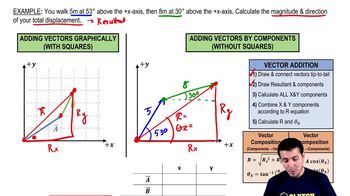
Vector Components

Vector components are the projections of a vector along the axes of a coordinate system. In the xy-plane, any vector can be decomposed into its x-component and y-component, represented by the unit vectors i and j. This decomposition simplifies calculations involving vectors, such as addition, subtraction, and finding magnitudes, by treating each component separately.
Recommended video:
Guided course
07:30
Vector Addition By Components
Related Practice