
Ch 10: Dynamics of Rotational Motion
Young & Freedman Calc - University Physics 15th Edition
Young & Freedman Calc15th EditionUniversity PhysicsISBN: 9780135159552Not the one you use?Change textbook
Chapter 10, Problem 7a

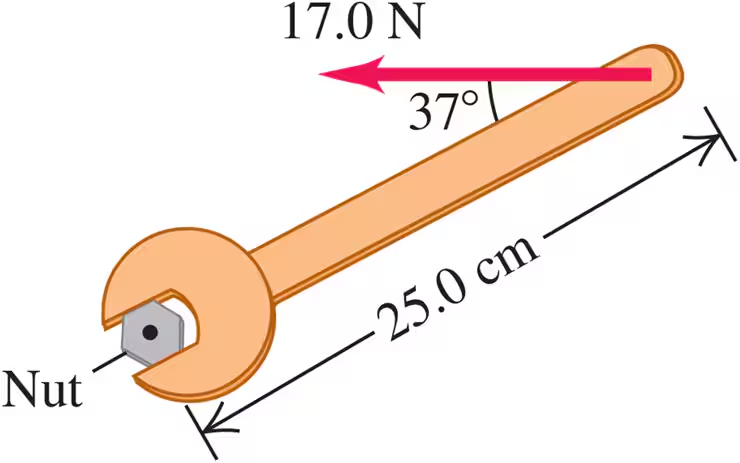
A machinist is using a wrench to loosen a nut. The wrench is 25.0 cm long, and he exerts a 17.0-N force at the end of the handle at 37° with the handle (Fig. E10.7). What torque does the machinist exert about the center of the nut?

Verified step by step guidance
1
Understand that torque (τ) is the measure of the force that can cause an object to rotate about an axis. It is calculated using the formula τ = r * F * sin(θ), where r is the distance from the axis of rotation to the point where the force is applied, F is the magnitude of the force, and θ is the angle between the force and the lever arm.
Identify the given values from the problem: the length of the wrench (r) is 25.0 cm, which needs to be converted to meters (0.25 m), the force (F) applied is 17.0 N, and the angle (θ) between the force and the wrench is 37°.
Convert the angle from degrees to radians if necessary, but in this case, you can use the sine function directly with degrees. Calculate sin(37°) using a calculator or trigonometric table.
Substitute the values into the torque formula: τ = 0.25 m * 17.0 N * sin(37°).
Perform the multiplication to find the torque exerted by the machinist about the center of the nut. Remember that the unit of torque is Newton-meter (N·m).

Verified video answer for a similar problem:

This video solution was recommended by our tutors as helpful for the problem above.
Video duration:
4m
Was this helpful?

Key Concepts

Here are the essential concepts you must grasp in order to answer the question correctly.

Torque

Torque is a measure of the rotational force applied to an object, calculated as the product of the force and the perpendicular distance from the pivot point to the line of action of the force. It is expressed in Newton-meters (Nm) and determines how effectively a force can cause an object to rotate.
Recommended video:
Guided course
08:55
Net Torque & Sign of Torque

Lever Arm

The lever arm is the perpendicular distance from the axis of rotation to the line of action of the force. In this problem, the lever arm is the length of the wrench, which is crucial for calculating torque. A longer lever arm increases the torque for the same amount of force applied.
Recommended video:
Guided course
06:58
Ice skater closes her arms

Angle of Force Application

The angle at which a force is applied affects the torque produced. Torque is maximized when the force is applied perpendicular to the lever arm. The effective component of the force contributing to torque is calculated using the sine of the angle between the force and the lever arm.
Recommended video:
Guided course
06:21
Force on Charge Moving at an Angle
Related Practice
Textbook Question

Three forces are applied to a wheel of radius 0.350 m, as shown in Fig. E10.4. One force is perpendicular to the rim, one is tangent to it, and the other one makes a 40.0° angle with the radius. What is the net torque on the wheel due to these three forces for an axis perpendicular to the wheel and passing through its center?

1
views
Textbook Question

A metal bar is in the xyxy-plane with one end of the bar at the origin. A force F=(7.00N)i+(3.00N)j\(\overrightarrow{F}\)=\(\left\)(7.00N\(\right\))i+(-3.00N)j is applied to the bar at the point x=3.00 mx=3.00\(\text{ m}\), y=4.00 my=4.00\(\text{ m}\). What are the magnitude and direction of the torque with respect to the origin produced by F\(\overrightarrow{F}\)?

1
views
Textbook Question

One force acting on a machine part is F = (-5.00 N)i + (4.00 N)j. The vector from the origin to the point where the force is applied is r = (-0.450 m)i +(0.150 m)j. In a sketch, show r, F, and the origin.

3
views
Textbook Question

A machinist is using a wrench to loosen a nut. The wrench is 25.0 cm long, and he exerts a 17.0-N force at the end of the handle at 37° with the handle (Fig. E10.7). What is the maximum torque he could exert with this force, and how should the force be oriented?

2
views
Textbook Question

The flywheel of an engine has moment of inertia 1.60 kg/m2 about its rotation axis. What constant torque is required to bring it up to an angular speed of 400 rev/min in 8.00 s, starting from rest?

1
views
Textbook Question

A metal bar is in the xyxy-plane with one end of the bar at the origin. A force F=(7.00N)i+(3.00N)j\(\overrightarrow{F}\)=\(\left\)(7.00N\(\right\))i+(-3.00N)j is applied to the bar at the point x=3.00 mx=3.00\(\text{ m}\), y=4.00 my=4.00\(\text{ m}\). In terms of unit vectors ii and jj, what is the position vector rr for the point where the force is applied?

2
views