
Ch 09: Rotation of Rigid Bodies
Young & Freedman Calc - University Physics 15th Edition
Young & Freedman Calc15th EditionUniversity PhysicsISBN: 9780135159552Not the one you use?Change textbook
Chapter 9, Problem 30c

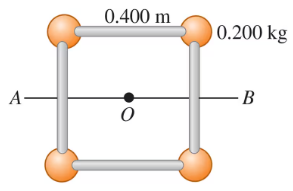
Four small spheres, each of which you can regard as a point of mass 0.200 kg, are arranged in a square 0.400 m on a side and connected by extremely light rods (Fig. E9.28). Find the moment of inertia of the system about an axis that passes through the centers of the upper left and lower right spheres and through point O.
Four orange spheres, each 0.200 kg, form a square with 0.400 m sides, connected by light rods, with point O at the center.

Verified step by step guidance
1
Step 1: Identify the geometry of the system. The four spheres are arranged in a rectangle with dimensions 50 cm (0.50 m) by 30 cm (0.30 m). The axis passes through the centers of the upper left and lower right spheres, forming a diagonal of the rectangle.
Step 2: Calculate the length of the diagonal of the rectangle using the Pythagorean theorem. The diagonal length is given by \( \sqrt{(0.50 \text{ m})^2 + (0.30 \text{ m})^2} \).
Step 3: Determine the perpendicular distance of each sphere from the axis. For the spheres located on the axis (upper left and lower right), the perpendicular distance is zero. For the other two spheres (upper right and lower left), the perpendicular distance is half the diagonal length, \( \frac{\text{diagonal}}{2} \).
Step 4: Use the formula for the moment of inertia of point masses: \( I = \sum m r^2 \), where \( m \) is the mass of each sphere and \( r \) is the perpendicular distance from the axis. Substitute \( m = 0.200 \text{ kg} \) and the calculated distances for each sphere.
Step 5: Add the contributions to the moment of inertia from all four spheres. For the spheres on the axis, their contribution is zero since \( r = 0 \). For the other two spheres, their contribution is \( m \left( \frac{\text{diagonal}}{2} \right)^2 \). Sum these values to find the total moment of inertia.

Verified video answer for a similar problem:

This video solution was recommended by our tutors as helpful for the problem above.
Video duration:
14m
Was this helpful?

Key Concepts

Here are the essential concepts you must grasp in order to answer the question correctly.

Moment of Inertia

The moment of inertia is a measure of an object's resistance to rotational motion about a specific axis. It depends on the mass distribution relative to that axis, calculated as the sum of the products of each mass and the square of its distance from the axis. For point masses, it is given by I = Σ(m_i * r_i²), where m_i is the mass and r_i is the distance from the axis.
Recommended video:
Guided course
11:47
Intro to Moment of Inertia

Parallel Axis Theorem

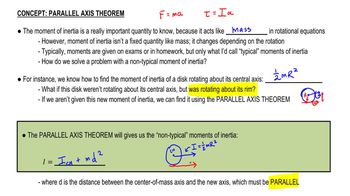
The parallel axis theorem allows the calculation of the moment of inertia of a body about any axis parallel to an axis through its center of mass. It states that I = I_cm + Md², where I_cm is the moment of inertia about the center of mass, M is the total mass, and d is the distance between the two axes. This theorem is essential for solving problems involving composite systems.
Recommended video:
Guided course
13:46
Parallel Axis Theorem

Coordinate System and Geometry

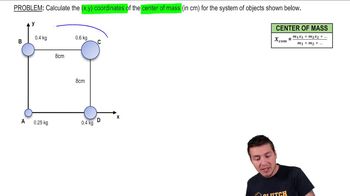
Understanding the geometry of the system and the coordinate system is crucial for calculating the moment of inertia. In this problem, the spheres are arranged in a square, and their positions relative to the chosen axis must be accurately determined. The distances from the axis to each mass must be calculated based on their coordinates to apply the moment of inertia formula correctly.
Recommended video:
Guided course
05:17
Coordinates of Center of Mass of 4 objects
Related Practice
Textbook Question

Calculate the moment of inertia of each of the following uniform objects about the axes indicated. Consult Table 9.2 as needed. A thin 2.50-kg rod of length 75.0 cm, about an axis perpendicular to it and passing through (i) one end and (ii) its center, and (iii) about an axis parallel to the rod and passing through it.

2
views
Textbook Question

A uniform bar has two small balls glued to its ends. The bar is 2.00 m long and has mass 4.00 kg, while the balls each have mass 0.300 kg and can be treated as point masses. Find the moment of inertia of this combination about an axis perpendicular to the bar through one of the balls;

2
views
Textbook Question

An electric turntable 0.750 m in diameter is rotating about a fixed axis with an initial angular velocity of 0.250 rev/s and a constant angular acceleration of 0.900 rev/s2.

(a) Compute the angular velocity of the turntable after 0.200 s.

(b) Through how many revolutions has the turntable spun in this time interval?

3
views
Textbook Question

A uniform bar has two small balls glued to its ends. The bar is 2.00 m long and has mass 4.00 kg, while the balls each have mass 0.300 kg and can be treated as point masses. Find the moment of inertia of this combination about an axis perpendicular to the bar through its center;

5
views
Textbook Question

An electric turntable 0.750 m in diameter is rotating about a fixed axis with an initial angular velocity of 0.250 rev/s and a constant angular acceleration of 0.900 rev/s2. What is the tangential speed of a point on the rim of the turntable at t = 0.200 s?

5
views
Textbook Question

An electric turntable 0.750 m in diameter is rotating about a fixed axis with an initial angular velocity of 0.250 rev/s and a constant angular acceleration of 0.900 rev/s2. What is the magnitude of the resultant acceleration of a point on the rim at t = 0.200 s?

2
views