
Ch 09: Rotation of Rigid Bodies
Young & Freedman Calc - University Physics 15th Edition
Young & Freedman Calc15th EditionUniversity PhysicsISBN: 9780135159552Not the one you use?Change textbook
Chapter 9, Problem 33a

A uniform bar has two small balls glued to its ends. The bar is 2.00 m long and has mass 4.00 kg, while the balls each have mass 0.300 kg and can be treated as point masses. Find the moment of inertia of this combination about an axis perpendicular to the bar through its center;

Verified step by step guidance
1
Step 1: Understand the problem. The moment of inertia is a measure of an object's resistance to rotational motion about a given axis. For this problem, the axis is perpendicular to the bar and passes through its center. The bar is uniform, and the balls are treated as point masses located at the ends of the bar.
Step 2: Break the problem into components. The total moment of inertia is the sum of the moment of inertia of the bar and the moments of inertia of the two balls. Use the formula for the moment of inertia of a uniform bar about its center: \( I_{bar} = \frac{1}{12} M L^2 \), where \( M \) is the mass of the bar and \( L \) is its length.
Step 3: Calculate the moment of inertia for each ball. Since the balls are treated as point masses, their moment of inertia is given by \( I_{ball} = m r^2 \), where \( m \) is the mass of the ball and \( r \) is the distance from the axis of rotation. For this problem, \( r \) is half the length of the bar (\( L/2 \)).
Step 4: Add the contributions to find the total moment of inertia. The total moment of inertia is \( I_{total} = I_{bar} + 2 \cdot I_{ball} \), where the factor of 2 accounts for the two balls.
Step 5: Substitute the given values into the formulas. Use \( M = 4.00 \; \text{kg} \), \( L = 2.00 \; \text{m} \), and \( m = 0.300 \; \text{kg} \) to compute \( I_{bar} \) and \( I_{ball} \), then sum them to find \( I_{total} \).

Verified video answer for a similar problem:

This video solution was recommended by our tutors as helpful for the problem above.
Video duration:
2m
Was this helpful?

Key Concepts

Here are the essential concepts you must grasp in order to answer the question correctly.

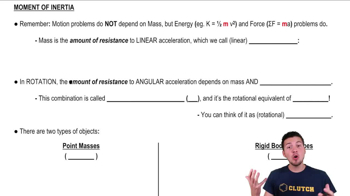
Moment of Inertia

Moment of inertia is a measure of an object's resistance to changes in its rotational motion about a specific axis. It depends on the mass distribution relative to that axis. For point masses, it is calculated as the product of the mass and the square of the distance from the axis of rotation. The greater the distance of the mass from the axis, the larger the moment of inertia.
Recommended video:
Guided course
11:47
Intro to Moment of Inertia

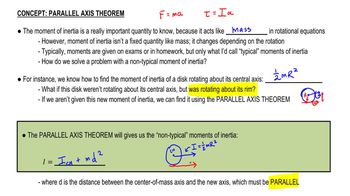
Parallel Axis Theorem

The parallel axis theorem allows us to calculate the moment of inertia of a body about any axis parallel to an axis through its center of mass. It states that the moment of inertia about the new axis is equal to the moment of inertia about the center of mass axis plus the product of the total mass and the square of the distance between the two axes. This theorem is particularly useful when dealing with composite bodies.
Recommended video:
Guided course
13:46
Parallel Axis Theorem

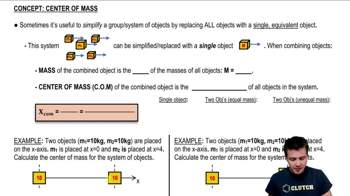
Center of Mass

The center of mass of a system is the point where the total mass of the system can be considered to be concentrated for the purpose of analyzing translational motion. For uniform objects, it is typically located at their geometric center. In this problem, understanding the center of mass is crucial for applying the parallel axis theorem and calculating the moment of inertia accurately.
Recommended video:
Guided course
06:30
Intro to Center of Mass
Related Practice
Textbook Question

Calculate the moment of inertia of each of the following uniform objects about the axes indicated. Consult Table 9.2 as needed. A thin 2.50-kg rod of length 75.0 cm, about an axis perpendicular to it and passing through (i) one end and (ii) its center, and (iii) about an axis parallel to the rod and passing through it.

2
views
Textbook Question

Four small spheres, each of which you can regard as a point of mass 0.200 kg, are arranged in a square 0.400 m on a side and connected by extremely light rods (Fig. E9.28). Find the moment of inertia of the system about an axis that passes through the centers of the upper left and lower right spheres and through point O.

11
views
Textbook Question

A uniform bar has two small balls glued to its ends. The bar is 2.00 m long and has mass 4.00 kg, while the balls each have mass 0.300 kg and can be treated as point masses. Find the moment of inertia of this combination about an axis parallel to the bar through both balls;

2
views
Textbook Question

A uniform bar has two small balls glued to its ends. The bar is 2.00 m long and has mass 4.00 kg, while the balls each have mass 0.300 kg and can be treated as point masses. Find the moment of inertia of this combination about an axis perpendicular to the bar through one of the balls;

2
views
Textbook Question

A uniform bar has two small balls glued to its ends. The bar is 2.00 m long and has mass 4.00 kg, while the balls each have mass 0.300 kg and can be treated as point masses. Find the moment of inertia of this combination about an axis parallel to the bar and 0.500 m from it.

Textbook Question

An electric turntable 0.750 m in diameter is rotating about a fixed axis with an initial angular velocity of 0.250 rev/s and a constant angular acceleration of 0.900 rev/s2. What is the magnitude of the resultant acceleration of a point on the rim at t = 0.200 s?

2
views