
Ch 05: Applying Newton's Laws
Young & Freedman Calc - University Physics 15th Edition
Young & Freedman Calc15th EditionUniversity PhysicsISBN: 9780135159552Not the one you use?Change textbook
Chapter 5, Problem 40a

You throw a baseball straight upward. The drag force is proportional to v2v^2. In terms of gg, what is the y y-component of the ball's acceleration when the ball's speed is half its terminal speed and it is moving up?

Verified step by step guidance
1
Step 1: Understand the forces acting on the baseball. When the ball is moving upward, the forces include gravity (mg, acting downward) and the drag force (proportional to υ², also acting downward). The net force determines the y-component of the acceleration.
Step 2: Recall the terminal velocity condition. At terminal velocity, the drag force equals the gravitational force, i.e., F_drag = mg. Since drag force is proportional to υ², we can write F_drag = kυ², where k is the proportionality constant. At terminal velocity, kυ_terminal² = mg.
Step 3: Relate the drag force to the current velocity. When the ball's speed is half its terminal speed (υ = 0.5υ_terminal), the drag force becomes F_drag = k(0.5υ_terminal)² = k(0.25υ_terminal²). Substitute kυ_terminal² = mg into this expression to find F_drag = 0.25mg.
Step 4: Write the net force equation. The net force acting on the ball is the sum of the gravitational force and the drag force, both acting downward. Thus, F_net = mg + 0.25mg = 1.25mg.
Step 5: Use Newton's second law to find the y-component of acceleration. The net force is related to acceleration by F_net = ma. Therefore, the y-component of acceleration is a_y = F_net / m = (1.25mg) / m = 1.25g. This is the y-component of the ball's acceleration when moving upward at half its terminal speed.

Verified video answer for a similar problem:

This video solution was recommended by our tutors as helpful for the problem above.
Video duration:
3m
Was this helpful?

Key Concepts

Here are the essential concepts you must grasp in order to answer the question correctly.

Terminal Velocity

Terminal velocity is the constant speed that a freely falling object eventually reaches when the resistance of the medium prevents further acceleration. For a baseball thrown upward, terminal velocity occurs when the gravitational force is balanced by the drag force, leading to zero net acceleration.
Recommended video:
Guided course
7:27
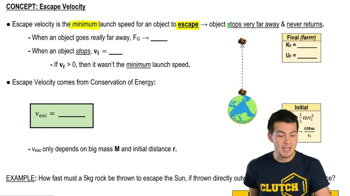
Escape Velocity

Drag Force

The drag force is a resistive force acting opposite to the direction of motion, often modeled as proportional to the square of the velocity (υ²). This means that as the speed of the baseball increases, the drag force increases significantly, affecting the ball's acceleration as it moves upward.
Recommended video:
Guided course
06:48
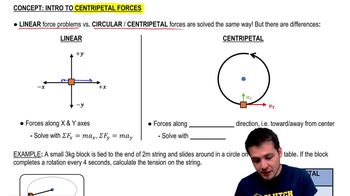
Intro to Centripetal Forces

Acceleration due to Gravity

Acceleration due to gravity (g) is the rate at which an object accelerates towards the Earth when in free fall, approximately 9.81 m/s². When analyzing the motion of the baseball, this acceleration acts downward, while the drag force acts upward, influencing the net acceleration of the ball as it ascends.
Recommended video:
Guided course
05:20
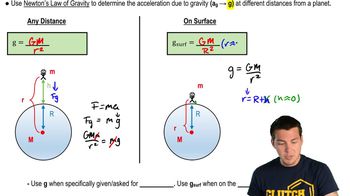
Acceleration Due to Gravity
Related Practice
Textbook Question

Two crates connected by a rope lie on a horizontal surface (Fig. E5.375.37). Crate A has mass mAm_A, and crate B has mass mBm_B. The coefficient of kinetic friction between each crate and the surface is μkμ_k. The crates are pulled to the right at constant velocity by a horizontal force FF. Draw one or more free-body diagrams to calculate the following in terms of mAm_A, mBm_B, and μkμ_k: the tension in the rope connecting the blocks.

7
views
Textbook Question

A 5252-kg ice skater spins about a vertical axis through her body with her arms horizontally outstretched; she makes 2.02.0 turns each second. The distance from one hand to the other is 1.501.50 m. Biometric measurements indicate that each hand typically makes up about 1.25%1.25\% of body weight. What horizontal force must her wrist exert on her hand?

4
views
Textbook Question

Two crates connected by a rope lie on a horizontal surface (Fig. E5.375.37). Crate A has mass mAm_A, and crate B has mass mBm_B. The coefficient of kinetic friction between each crate and the surface is μkμ_k. The crates are pulled to the right at constant velocity by a horizontal force FF. Draw one or more free-body diagrams to calculate the following in terms of mAm_A, mBm_B, and μkμ_k: the magnitude of FF.

5
views
Textbook Question

You throw a baseball straight upward. The drag force is proportional to v2v^2. In terms of gg, what is the y y-component of the ball's acceleration when the ball's speed is half its terminal speed and it is moving back down?

2
views
Textbook Question

A small remote-controlled car with mass 1.601.60 kg moves at a constant speed of v=12.0v = 12.0 m/s in a track formed by a vertical circle inside a hollow metal cylinder that has a radius of 5.005.00 m (Fig. E5.455.45). What is the magnitude of the normal force exerted on the car by the walls of the cylinder at point AA (bottom of the track)?

1
views
Textbook Question

A 25.025.0-kg box of textbooks rests on a loading ramp that makes an angle αα with the horizontal. The coefficient of kinetic friction is 0.250.25, and the coefficient of static friction is 0.350.35. At this angle, find the acceleration once the box has begun to move.

1
views