
Ch 05: Applying Newton's Laws
Young & Freedman Calc - University Physics 15th Edition
Young & Freedman Calc15th EditionUniversity PhysicsISBN: 9780135159552Not the one you use?Change textbook
Chapter 5, Problem 36b

A 25.025.0-kg box of textbooks rests on a loading ramp that makes an angle αα with the horizontal. The coefficient of kinetic friction is 0.250.25, and the coefficient of static friction is 0.350.35. At this angle, find the acceleration once the box has begun to move.

Verified step by step guidance
1
Step 1: Begin by identifying the forces acting on the box. These include the gravitational force (weight), the normal force, and the force of kinetic friction. The gravitational force can be broken into two components: one parallel to the ramp (\( F_{g, \text{parallel}} = m g \sin \alpha \)) and one perpendicular to the ramp (\( F_{g, \text{perpendicular}} = m g \cos \alpha \)).
Step 2: Calculate the force of kinetic friction using the formula \( F_{\text{friction}} = \mu_k F_{\text{normal}} \), where \( \mu_k \) is the coefficient of kinetic friction and \( F_{\text{normal}} \) is the normal force. The normal force is equal to \( F_{g, \text{perpendicular}} \), which is \( m g \cos \alpha \).
Step 3: Determine the net force acting on the box along the ramp. The net force is the difference between the parallel component of the gravitational force and the force of kinetic friction: \( F_{\text{net}} = F_{g, \text{parallel}} - F_{\text{friction}} \). Substitute \( F_{g, \text{parallel}} = m g \sin \alpha \) and \( F_{\text{friction}} = \mu_k m g \cos \alpha \) into this equation.
Step 4: Use Newton's second law, \( F_{\text{net}} = m a \), to solve for the acceleration \( a \). Rearrange the equation to \( a = \frac{F_{\text{net}}}{m} \). Substitute \( F_{\text{net}} \) from Step 3 into this formula.
Step 5: Simplify the expression for acceleration: \( a = g (\sin \alpha - \mu_k \cos \alpha) \). This formula gives the acceleration of the box once it has begun to move. Plug in the given values for \( g \), \( \mu_k \), and \( \alpha \) to calculate the numerical result.

Verified video answer for a similar problem:

This video solution was recommended by our tutors as helpful for the problem above.
Video duration:
9m
Was this helpful?

Key Concepts

Here are the essential concepts you must grasp in order to answer the question correctly.

Newton's Second Law of Motion

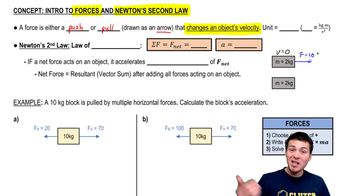
Newton's Second Law states that the acceleration of an object is directly proportional to the net force acting on it and inversely proportional to its mass. This principle is essential for analyzing the forces acting on the box as it moves down the ramp, allowing us to calculate the acceleration by applying the formula F_net = m * a.
Recommended video:
Guided course
06:54
Intro to Forces & Newton's Second Law

Frictional Forces

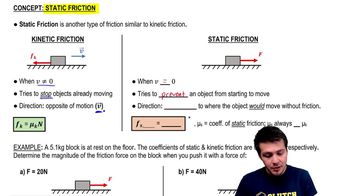
Frictional forces oppose the motion of an object and are categorized into static and kinetic friction. The coefficient of static friction applies when the box is at rest, while the coefficient of kinetic friction is relevant once the box starts moving. Understanding these coefficients helps determine the net force acting on the box as it accelerates down the ramp.
Recommended video:
Guided course
08:11
Static Friction & Equilibrium

Inclined Plane Dynamics

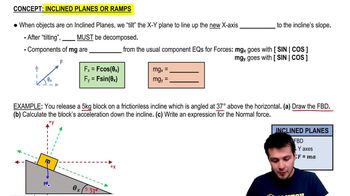
When analyzing objects on an inclined plane, the gravitational force acting on the object can be resolved into components parallel and perpendicular to the surface. The angle of the ramp affects these components, influencing both the normal force and the frictional force, which are critical for calculating the net force and resulting acceleration of the box.
Recommended video:
Guided course
06:59
Intro to Inclined Planes
Related Practice
Textbook Question

A pickup truck is carrying a toolbox, but the rear gate of the truck is missing. The toolbox will slide out if it is set moving. The coefficients of kinetic friction and static friction between the box and the level bed of the truck are 0.3550.355 and 0.6500.650, respectively. Starting from rest, what is the shortest time this truck could accelerate uniformly to 30.030.0 m/s without causing the box to slide? Draw a free-body diagram of the toolbox.

3
views
Textbook Question

Two crates connected by a rope lie on a horizontal surface (Fig. E5.375.37). Crate A has mass mAm_A, and crate B has mass mBm_B. The coefficient of kinetic friction between each crate and the surface is μkμ_k. The crates are pulled to the right at constant velocity by a horizontal force FF. Draw one or more free-body diagrams to calculate the following in terms of mAm_A, mBm_B, and μkμ_k: the tension in the rope connecting the blocks.

7
views
Textbook Question

Two crates connected by a rope lie on a horizontal surface (Fig. E5.375.37). Crate A has mass mAm_A, and crate B has mass mBm_B. The coefficient of kinetic friction between each crate and the surface is μkμ_k. The crates are pulled to the right at constant velocity by a horizontal force FF. Draw one or more free-body diagrams to calculate the following in terms of mAm_A, mBm_B, and μkμ_k: the magnitude of FF.

5
views
Textbook Question

A 45.045.0-kg crate of tools rests on a horizontal floor. You exert a gradually increasing horizontal push on it, and the crate just begins to move when your force exceeds 313313 N. Then you must reduce your push to 208208 N to keep it moving at a steady 25.025.0 cm/s. Suppose you were performing the same experiment on the moon, where the acceleration due to gravity is 1.621.62 m/s2.

(i) What magnitude push would cause it to move?

(ii) What would its acceleration be if you maintained the push in part (b)? Note: Part (b) asked what push you must exert to give it an acceleration of 1.101.10 m/s2.

2
views
Textbook Question

A 45.045.0-kg crate of tools rests on a horizontal floor. You exert a gradually increasing horizontal push on it, and the crate just begins to move when your force exceeds 313313 N. Then you must reduce your push to 208208 N to keep it moving at a steady 25.025.0 cm/s. What push must you exert to give it an acceleration of 1.101.10 m/s2?

3
views
Textbook Question

You throw a baseball straight upward. The drag force is proportional to v2v^2. In terms of gg, what is the y y-component of the ball's acceleration when the ball's speed is half its terminal speed and it is moving up?

3
views