
When jumping straight up from a crouched position, an average person can reach a maximum height of about cm. During the jump, the person's body from the knees up typically rises a distance of around cm. To keep the calculations simple and yet get a reasonable result, assume that the entire body rises this much during the jump. In terms of this jumper's weight w, what force does the ground exert on him or her during the jump?
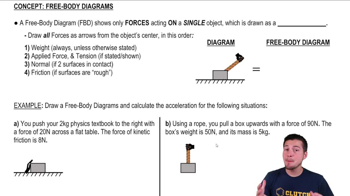
When jumping straight up from a crouched position, an average person can reach a maximum height of about cm. During the jump, the person's body from the knees up typically rises a distance of around cm. To keep the calculations simple and yet get a reasonable result, assume that the entire body rises this much during the jump. Draw a free-body diagram of the person during the jump.
Verified step by step guidance
Verified video answer for a similar problem:
Key Concepts
Free-Body Diagram
Forces in Motion
Kinematics
A -kg crate is suspended from the end of a short vertical rope of negligible mass. An upward force is applied to the end of the rope, and the height of the crate above its initial position is given by ( m/s)t + ( m/s3)t3. What is the magnitude of when s?
A light rope is attached to a block with mass kg that rests on a frictionless, horizontal surface. The horizontal rope passes over a frictionless, massless pulley, and a block with mass m is suspended from the other end. When the blocks are released, the tension in the rope is N. Find .
When jumping straight up from a crouched position, an average person can reach a maximum height of about cm. During the jump, the person's body from the knees up typically rises a distance of around cm. To keep the calculations simple and yet get a reasonable result, assume that the entire body rises this much during the jump. With what initial speed does the person leave the ground to reach a height of cm?
A -kg box is moving to the right with speed m/s on a horizontal, frictionless surface. At a horizontal force is applied to the box. The force is directed to the left and has magnitude ( N/s2)t2. What distance does the box move from its position at before its speed is reduced to zero?
A light rope is attached to a block with mass kg that rests on a frictionless, horizontal surface. The horizontal rope passes over a frictionless, massless pulley, and a block with mass is suspended from the other end. When the blocks are released, the tension in the rope is N. How does the tension compare to the weight of the hanging block?
