Ch 05: Applying Newton's Laws
Young & Freedman Calc - University Physics 15th Edition
Young & Freedman Calc15th EditionUniversity PhysicsISBN: 9780135159552Not the one you use?Change textbook
Chapter 5, Problem 21a

A 2.002.00-kg box is moving to the right with speed 9.009.00 m/s on a horizontal, frictionless surface. At t=0t = 0 a horizontal force is applied to the box. The force is directed to the left and has magnitude F(t)=F(t) = (6.006.00 N/s2)t2. What distance does the box move from its position at t=0t = 0 before its speed is reduced to zero?

Verified step by step guidance
1
Step 1: Start by identifying the key variables and equations. The box has an initial mass \( m = 2.00 \; \text{kg} \), an initial velocity \( v_0 = 9.00 \; \text{m/s} \), and a force \( F(t) = (6.00 \; \text{N/s}^2)t^2 \) acting to the left. The goal is to find the distance the box travels before its speed is reduced to zero.
Step 2: Use Newton's second law \( F = ma \) to find the acceleration as a function of time. Since \( F(t) = (6.00 \; \text{N/s}^2)t^2 \), the acceleration is \( a(t) = \frac{F(t)}{m} = \frac{(6.00 \; \text{N/s}^2)t^2}{2.00 \; \text{kg}} = 3.00t^2 \; \text{m/s}^2 \).
Step 3: Relate acceleration to velocity. The acceleration is the time derivative of velocity, so \( a(t) = \frac{dv}{dt} \). Substituting \( a(t) = 3.00t^2 \), we have \( \frac{dv}{dt} = 3.00t^2 \). Integrate this equation with respect to time to find the velocity as a function of time: \( v(t) = v_0 - \int 3.00t^2 dt = 9.00 - t^3 \; \text{m/s} \).
Step 4: Determine the time \( t \) when the velocity becomes zero. Set \( v(t) = 0 \): \( 9.00 - t^3 = 0 \). Solve for \( t \): \( t^3 = 9.00 \), so \( t = \sqrt[3]{9.00} \; \text{s} \).
Step 5: Calculate the distance traveled. The velocity is the time derivative of position, so \( v(t) = \frac{dx}{dt} \). Substituting \( v(t) = 9.00 - t^3 \), we have \( \frac{dx}{dt} = 9.00 - t^3 \). Integrate this equation with respect to time to find the position \( x(t) \): \( x(t) = \int (9.00 - t^3) dt = 9.00t - \frac{t^4}{4} + C \). At \( t = 0 \), the initial position is \( x(0) = 0 \), so \( C = 0 \). The distance traveled is \( x(t) \) evaluated at \( t = \sqrt[3]{9.00} \): \( x(\sqrt[3]{9.00}) = 9.00(\sqrt[3]{9.00}) - \frac{(\sqrt[3]{9.00})^4}{4} \).

Verified video answer for a similar problem:

This video solution was recommended by our tutors as helpful for the problem above.
Video duration:
8m
Was this helpful?

Key Concepts

Here are the essential concepts you must grasp in order to answer the question correctly.

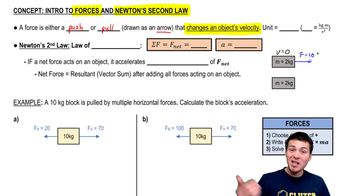
Newton's Second Law of Motion

Newton's Second Law states that the acceleration of an object is directly proportional to the net force acting on it and inversely proportional to its mass. This relationship is expressed by the equation F = ma, where F is the net force, m is the mass, and a is the acceleration. In this scenario, the applied force affects the box's acceleration, which is crucial for determining how its velocity changes over time.
Recommended video:
Guided course
06:54
Intro to Forces & Newton's Second Law

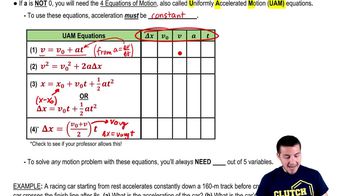
Kinematics Equations

Kinematics equations describe the motion of objects under constant acceleration. They relate displacement, initial velocity, final velocity, acceleration, and time. In this problem, we need to integrate the acceleration (derived from the force) to find the velocity as a function of time, and then use that to determine the distance traveled before the box comes to a stop.
Recommended video:
Guided course
08:25
Kinematics Equations

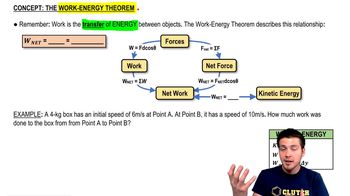
Work-Energy Principle

The Work-Energy Principle states that the work done on an object is equal to the change in its kinetic energy. In this case, the work done by the applied force will reduce the kinetic energy of the box until it comes to a stop. Understanding this principle allows us to relate the force applied over a distance to the change in the box's speed, facilitating the calculation of the distance traveled before it stops.
Recommended video:
Guided course
04:10
The Work-Energy Theorem
Related Practice
Textbook Question

When jumping straight up from a crouched position, an average person can reach a maximum height of about 6060 cm. During the jump, the person's body from the knees up typically rises a distance of around 5050 cm. To keep the calculations simple and yet get a reasonable result, assume that the entire body rises this much during the jump. In terms of this jumper's weight w, what force does the ground exert on him or her during the jump?

1
views
Textbook Question

A 5.005.00-kg crate is suspended from the end of a short vertical rope of negligible mass. An upward force F(t)F(t) is applied to the end of the rope, and the height of the crate above its initial position is given by y(t)=y(t) = (2.802.80 m/s)t + (0.6100.610 m/s3)t3. What is the magnitude of FF when t=4.00t = 4.00 s?

2
views
Textbook Question

When jumping straight up from a crouched position, an average person can reach a maximum height of about 6060 cm. During the jump, the person's body from the knees up typically rises a distance of around 5050 cm. To keep the calculations simple and yet get a reasonable result, assume that the entire body rises this much during the jump. Draw a free-body diagram of the person during the jump.

2
views
Textbook Question

When jumping straight up from a crouched position, an average person can reach a maximum height of about 6060 cm. During the jump, the person's body from the knees up typically rises a distance of around 5050 cm. To keep the calculations simple and yet get a reasonable result, assume that the entire body rises this much during the jump. With what initial speed does the person leave the ground to reach a height of 6060 cm?

3
views
Textbook Question

In a laboratory experiment on friction, a 135135-N block resting on a rough horizontal table is pulled by a horizontal wire. The pull gradually increases until the block begins to move and continues to increase thereafter. Figure E5.265.26 shows a graph of the friction force on this block as a function of the pull. Identify the regions of the graph where static friction and kinetic friction occur.

9
views
Textbook Question

A box of bananas weighing 40.0 40.0 N rests on a horizontal surface. The coefficient of static friction between the box and the surface is 0.400.40, and the coefficient of kinetic friction is 0.200.20. If no horizontal force is applied to the box and the box is at rest, how large is the friction force exerted on it?

2
views