
The 'Giant Swing' at a county fair consists of a vertical central shaft with a number of horizontal arms attached at its upper end. Each arm supports a seat suspended from a cable m long, and the upper end of the cable is fastened to the arm at a point m from the central shaft (Fig. E). Find the time of one revolution of the swing if the cable supporting a seat makes an angle of with the vertical.
A flat (unbanked) curve on a highway has a radius of m. A car rounds the curve at a speed of m/s. What is the minimum coefficient of static friction that will prevent sliding?
Verified step by step guidance
Verified video answer for a similar problem:
Key Concepts
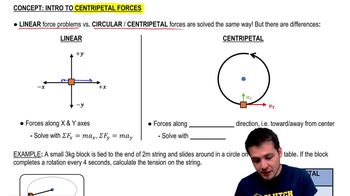
Centripetal Force
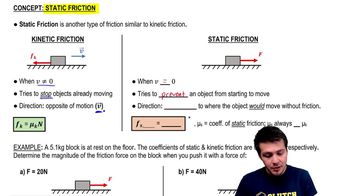
Friction and Coefficient of Friction
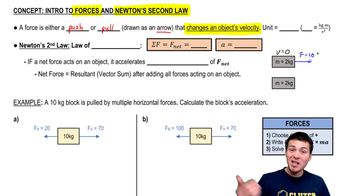
Newton's Second Law of Motion
A -kg car and a -kg pickup truck approach a curve on a highway that has a radius of m. At what angle should the highway engineer bank this curve so that vehicles traveling at mi/h can safely round it regardless of the condition of their tires? Should the heavy truck go slower than the lighter car?
A small remote-controlled car with mass kg moves at a constant speed of m/s in a track formed by a vertical circle inside a hollow metal cylinder that has a radius of m (Fig. E). What is the magnitude of the normal force exerted on the car by the walls of the cylinder at point (bottom of the track)?
In another version of the 'Giant Swing' (see Exercise ), the seat is connected to two cables, one of which is horizontal (Fig. E). The seat swings in a horizontal circle at a rate of rpm (rev/min). If the seat weighs N and an -N person is sitting in it, find the tension in each cable.
A small remote-controlled car with mass kg moves at a constant speed of m/s in a track formed by a vertical circle inside a hollow metal cylinder that has a radius of m (Fig. E). What is the magnitude of the normal force exerted on the car by the walls of the cylinder at point (top of the track)?
A small car with mass kg travels at constant speed on the inside of a track that is a vertical circle with radius m (Fig. E). If the normal force exerted by the track on the car when it is at the top of the track (point ) is N, what is the normal force on the car when it is at the bottom of the track (point )?
