Ch 05: Applying Newton's Laws
Young & Freedman Calc - University Physics 15th Edition
Young & Freedman Calc15th EditionUniversity PhysicsISBN: 9780135159552Not the one you use?Change textbook
Chapter 5, Problem 46

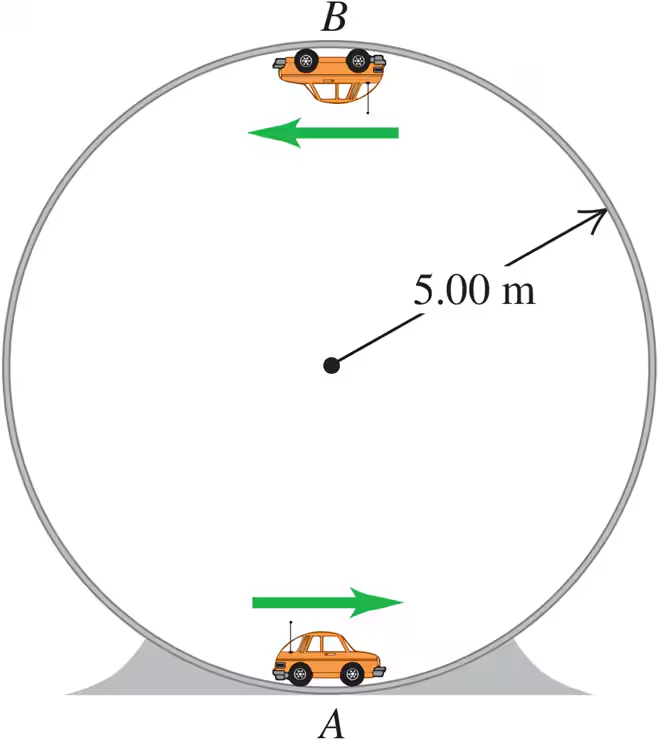
A small car with mass 0.8000.800 kg travels at constant speed on the inside of a track that is a vertical circle with radius 5.005.00 m (Fig. E5.455.45). If the normal force exerted by the track on the car when it is at the top of the track (point BB) is 6.006.00 N, what is the normal force on the car when it is at the bottom of the track (point AA)?
A diagram showing a small car on a vertical circular track, with points A and B labeled, and a radius of 5.00 m indicated.

Verified step by step guidance
1
Step 1: Identify the forces acting on the car at the top of the track (point B). These include the gravitational force (mg) acting downward and the normal force (N_top) exerted by the track, also acting downward. The net force at the top is the centripetal force required to keep the car moving in a circular path.
Step 2: Write the equation for the net force at the top of the track using Newton's second law. The centripetal force is provided by the sum of the gravitational force and the normal force: Fnet=Ntop+mg. The centripetal force is also expressed as mv2/r, where v is the speed of the car and r is the radius of the circular track.
Step 3: Solve for the speed of the car (v) using the forces at the top of the track. Rearrange the equation: v2=r(Ntop+mg)/m. Substitute the given values for mass (m = 0.800 kg), radius (r = 5.00 m), normal force at the top (N_top = 6.00 N), and gravitational acceleration (g = 9.80 m/s²).
Step 4: At the bottom of the track (point A), the forces acting on the car are the gravitational force (mg) acting downward and the normal force (N_bottom) exerted by the track acting upward. The net force at the bottom is again the centripetal force required to keep the car moving in a circular path. Write the equation for the net force at the bottom: Nbottom-mg=mv2/r.
Step 5: Solve for the normal force at the bottom (N_bottom) by rearranging the equation: Nbottom=mv2/r+mg. Substitute the values for mass, radius, gravitational acceleration, and the speed of the car (v) calculated in Step 3 to find the normal force at the bottom.

Verified video answer for a similar problem:

This video solution was recommended by our tutors as helpful for the problem above.
Video duration:
2m
Was this helpful?

Key Concepts

Here are the essential concepts you must grasp in order to answer the question correctly.

Centripetal Force

Centripetal force is the net force acting on an object moving in a circular path, directed towards the center of the circle. For an object in vertical circular motion, this force is crucial for maintaining the circular trajectory. At the top of the circle, the gravitational force and the normal force both contribute to the centripetal force, while at the bottom, the normal force must overcome gravity to provide the necessary centripetal force.
Recommended video:
Guided course
06:48
Intro to Centripetal Forces

Normal Force

The normal force is the force exerted by a surface to support the weight of an object resting on it, acting perpendicular to the surface. In the context of circular motion, the normal force varies depending on the position of the object in the circle. At the top of the track, the normal force is reduced due to the gravitational force acting in the same direction, while at the bottom, it must counteract gravity and provide additional force for centripetal acceleration.
Recommended video:
Guided course
08:17
The Normal Force

Newton's Second Law

Newton's Second Law states that the acceleration of an object is directly proportional to the net force acting on it and inversely proportional to its mass, expressed as F = ma. This principle is essential for analyzing forces in circular motion, as it allows us to calculate the net force required for the car to maintain its circular path. By applying this law at different points in the circular motion, we can determine the normal force at the bottom of the track.
Recommended video:
Guided course
06:54
Intro to Forces & Newton's Second Law
Related Practice
Textbook Question

The 'Giant Swing' at a county fair consists of a vertical central shaft with a number of horizontal arms attached at its upper end. Each arm supports a seat suspended from a cable 5.005.00 m long, and the upper end of the cable is fastened to the arm at a point 3.003.00 m from the central shaft (Fig. E5.505.50). Find the time of one revolution of the swing if the cable supporting a seat makes an angle of 30.0°30.0° with the vertical.

1
views
Textbook Question

A 5252-kg ice skater spins about a vertical axis through her body with her arms horizontally outstretched; she makes 2.02.0 turns each second. The distance from one hand to the other is 1.501.50 m. Biometric measurements indicate that each hand typically makes up about 1.25%1.25\% of body weight. What horizontal force must her wrist exert on her hand?

4
views
Textbook Question

A 11251125-kg car and a 22502250-kg pickup truck approach a curve on a highway that has a radius of 225 225 m. At what angle should the highway engineer bank this curve so that vehicles traveling at 65.065.0 mi/h can safely round it regardless of the condition of their tires? Should the heavy truck go slower than the lighter car?

2
views
Textbook Question

A small remote-controlled car with mass 1.601.60 kg moves at a constant speed of v=12.0v = 12.0 m/s in a track formed by a vertical circle inside a hollow metal cylinder that has a radius of 5.005.00 m (Fig. E5.455.45). What is the magnitude of the normal force exerted on the car by the walls of the cylinder at point AA (bottom of the track)?

1
views
Textbook Question

A flat (unbanked) curve on a highway has a radius of 170.0170.0 m. A car rounds the curve at a speed of 25.025.0 m/s. What is the minimum coefficient of static friction that will prevent sliding?

3
views
Textbook Question

A small remote-controlled car with mass 1.601.60 kg moves at a constant speed of v=12.0v = 12.0 m/s in a track formed by a vertical circle inside a hollow metal cylinder that has a radius of 5.005.00 m (Fig. E5.455.45). What is the magnitude of the normal force exerted on the car by the walls of the cylinder at point BB (top of the track)?

2
views